

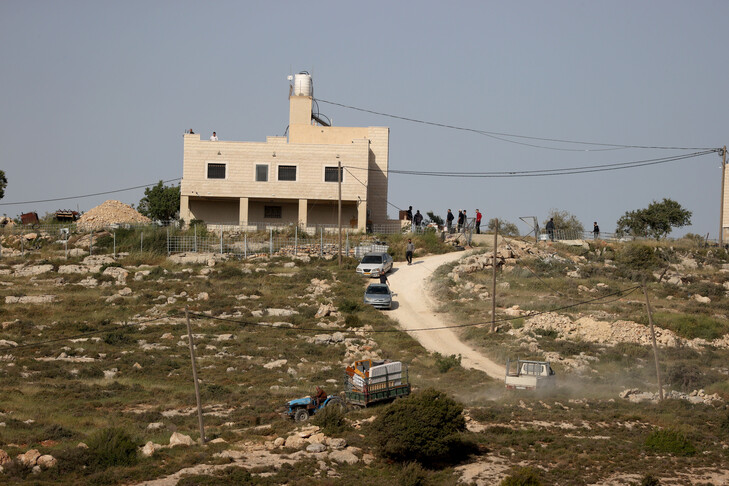
The Palestinian Wall and Settlement Resistance Commission said that 93.6 percent of files on terrorist attacks committed by Israeli settlers in the occupied West Bank between 2005 and 2025 did not lead to indictments.
This was stated in a policy paper by the commission titled 'Siege of Palestinian Homes and Communities by Settlers: A Policy Paper on Prolonged Isolation and Pressure for Displacement,' which reviewed documented violations up to 23 November of last year in the governorates of Nablus, Ramallah, Hebron, Tubas, Jericho and Jerusalem. The commission pointed out that the absence of accountability provides an environment for the continuation of attacks targeting Palestinians and their property and pushing them to leave their areas of residence.
Siege of Homes and Communities in Nablus, Ramallah and Hebron
The paper documented prolonged sieges in several areas, most notably the village of Jalud south of Nablus, where the Tubasi family was forced to leave their two homes after a siege lasting 95 days. The siege included threats, stone-throwing, cutting off water and electricity, and closing the road leading to the home, while the family was unable to return following an attack and acts of arson and sabotage.
In the neighboring town of Qusra, 3 homes sheltering about 13 people were isolated, restrictions were imposed on the access of water, food and supplies to them, and an ambulance trying to evacuate a sick child was obstructed. In the same town, settlers besieged for more than an hour a building under construction belonging to Palestinian Lu'ay al-Beiruti, in which 7 people were present.
The paper recorded other sieges, including the siege of the home of Mohammed Thabet Majed Hassoun in the town of Beit Imrin north of Nablus for more than 3 hours on 16 August 2026, before the Israeli army intervened and arrested the 9 people inside. It also documented the siege of the home of Shadi al-Alami in Wadi al-Sheikh in the town of Beit Amr north of Hebron, and the home of Qutaiba Muslim Abu Hamdeh in Khirbet al-Marajim south of Nablus, on 20 November of this month.
In the village of Umm Safa northwest of Ramallah, a gate was erected on the only road leading to the home of Mohammed al-Obeidat, which shelters about 15 people, obstructing the exit of patients and children's access to schools, at the same time as a demolition notice was issued for the home. In the town of Turmus Ayya north of Ramallah, restrictions were imposed on access to the home of the Abu Awad family, while the Israeli army seized the home of Naji Abu Jouda Awad and turned it into a military barracks since 25 October of last year.
In Wadi al-Rakhim in Masafer Yatta south of Hebron, the home of Yusef Shanaran was besieged, and water and basic needs were prevented from reaching his family except through coordination and military escort, while the siege reached 50 days as of 23 November.
Displacement of Communities in Tubas, Jericho, the Jordan Valley and Jerusalem
In the neighboring Khallet al-Hummus, two homes belonging to Samir Obeid and Mohammed Abu Tuhfa were besieged, and the Obeid family was prevented from returning to their home. The home of Ikhlas Salem al-Hathalin in the Umm al-Khair community was also encircled, including the livestock pen and sanitary facilities.
In the Ras al-Ahmar area south-east of Tubas, road closures, restrictions on bringing in water and fodder, and sabotage of about 1,000 meters of a water line led to the displacement of 24 families comprising 94 people, including 40 children, while 4 families remained, according to a statement dated 5 November.
In the Ras Ein al-Auja community north of Jericho, all residents, numbering about 600 people, were displaced after an outpost was established, roads and electricity were cut, and access to water and school was restricted. The paper also documented the displacement of 19 people from the Hadidiya community in the northern Jordan Valley, following the establishment of a new outpost, the cutting of electricity, the theft of water tanks and the prevention of grazing.
In the Arab al-Mleihat community in the Ma'arjat area west of Jericho, the home of Suleiman Musa Kaabneh, which houses 7 people, was surrounded with barbed wire, while about 20 families began leaving the community in July 2025.
East of Jerusalem, an outpost was established near the Mahtosh community, and the water line feeding it and the Araqib and Tabbaneh communities was cut, before the Mahtosh and Tabbaneh communities were fenced with barbed wire, restricting residents' movement, grazing and communication between the two communities.
Linking the Violations to the Israeli Government and the Commission's Demands
The commission linked these violations to the funding, arming, political cover and protection that the Israeli government provides to settlers, as well as their impunity from punishment.
The commission called for an urgent response that ensures the opening of roads and the delivery of water, food, medicine and basic services to besieged communities, and the protection of Palestinians and their property. It also demanded holding the perpetrators of attacks and the entities supporting them accountable, and enabling displaced families to safely return to their homes.
Source: Anadolu Agency
Comments (0)