

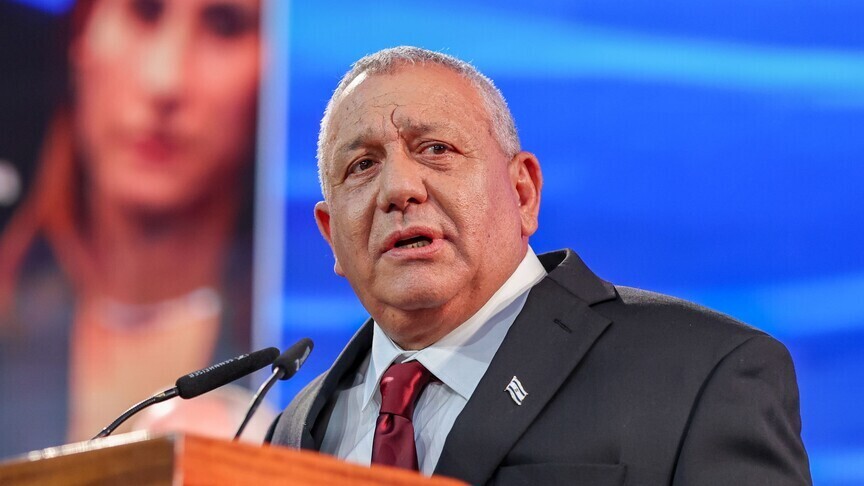
The Israeli Broadcasting Corporation reported on Tuesday evening a significant advance in government formation negotiations between the "Yesh Atid" party, led by Gadi Eisenkot, and the Haredi "Yahadut HaTorah" party, led by Ya'akov Asher.
Expectations that Talks Will Move into the Public Phase
The corporation said the talks between the two parties are expected to become "public next week, unless a sudden crisis occurs over the weekend." According to the corporation, "the move to public negotiations is expected to mark a new phase in the talks," meaning that all parties are ready to pay political prices to conduct these contacts, and that the core issues at the center of the dispute are already behind them.
Dispute over Halting the Arrest of Draft Evaders
However, according to the corporation, the main dispute concerns halting the arrest of draft evaders. The Haredim want a law passed before the government takes the constitutional oath, while Eisenkot believes it is more appropriate to adopt a government decision on this matter after the government is formed.
In the same context, the newspaper "Maariv" reported that the talks aimed at forming a government headed by Eisenkot "have entered a decisive phase," after Ya'akov Asher, leader of Yahadut HaTorah, briefed the rabbis over the past 24 hours on the progress made in negotiations with the "Change Bloc" and obtained their approval to continue the contacts. The newspaper added that the informal talks between the two sides are expected to advance to a more developed stage, while the Change Bloc is simultaneously studying several scenarios for forming a government, even without reaching a full coalition agreement with the Haredi parties.
Scenarios for Forming a Minority Government
According to "Maariv," the options on the table include forming a minority government through the abstention of the two Arab lists and "Yahadut HaTorah" (7 seats). Under this scenario, Yahadut HaTorah's abstention could enable Eisenkot to obtain a simple majority in the confidence vote and form the government, even if the Haredi Shas party votes against it.
The parties of the "Change Bloc" include Yesh Atid (21 of the 120 seats in the Knesset), "Together" led by Naftali Bennett (12 seats), "The Democrats" led by Yair Golan (8 seats), and "Yisrael Beiteinu" led by Avigdor Liberman (7 seats), totaling 48 seats combined. The parties of Netanyahu's camp hold 53 seats, and if Yahadut HaTorah abstains it would have only 46 votes, which would make forming a minority government easier, with the abstention of the two Arab lists, which hold 19 seats.
"Maariv" said this option could allow the formation of the government without Yahadut HaTorah being required to join it formally or vote in its favor. However, at this stage the matter remains a formula under study, not an agreement reached by the two sides.
Position of the Haredim and Hebrew Channels
For its part, the newspaper "Yedioth Ahronoth" said Yahadut HaTorah is preparing to begin formal negotiations with Eisenkot's party and, to that end, is working to form an official team to discuss the conditions for joining the government publicly.
Channel 13, a private Hebrew channel, said Eisenkot informed his partners in the "Change Bloc" on Tuesday evening of a "significant progress" in talks with Yahadut HaTorah, and noted that he "estimates that he will be able to have the government take the constitutional oath before the required deadline expires." According to the channel, Eisenkot told his partners that talks with Likud, led by outgoing Prime Minister Benjamin Netanyahu, are not making progress at this stage.
Constitutional Deadline and Formation Difficulties
The initial deadline given to Eisenkot to form the government expires on December 6, after which he may request an extension of 14 additional days. Eisenkot has been negotiating to form a government since he was tasked with doing so on November 8, without announcing any notable progress.
Eisenkot faces difficulties because the four parties in his camp lack an absolute majority in the Knesset (61 of the 120 seats), which makes him dependent on the support of other parties to pass his government in parliament, in addition to the differing positions of his allies on potential coalition partners. Bennett prefers forming a unity government with Netanyahu's Likud, while Liberman pushes for an alliance with ultra-Orthodox parties. In contrast, Golan rejects Netanyahu's participation in the government and prefers forming it with the support of the Arab parties.
If Eisenkot's government wins the confidence of the Knesset, it will officially be formed, and its head and members will take the legal oath, thereby ending the mandate of the current government headed by Netanyahu.
Source: Anadolu Agency
Comments (0)