

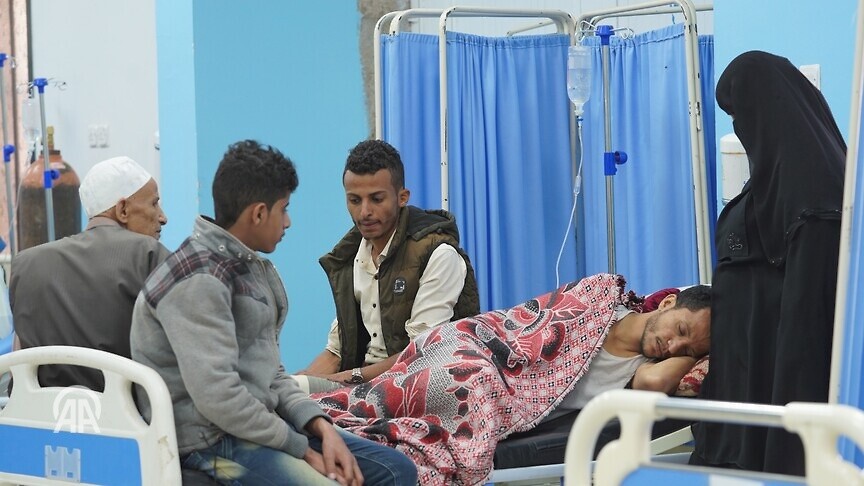
The suffering of thousands of patients in the city of Taiz in southwestern Yemen is worsening, especially those with cancer and kidney failure, due to shortages of medicines and medical supplies and difficulty reaching hospitals and treatment centers, as a result of the siege imposed on the city by the Houthi group.
Severe Shortage of Medical Supplies
The siege has led to a sharp decline in medicine supplies and a shortage of medical equipment and supplies, as well as rising operating costs, in addition to the difficulty for patients and medical staff to reach health facilities. Some health facilities face the risk of halting their services, in a country suffering one of the worst humanitarian and economic crises in the world.
On November 6, the medical and environmental committee in Taiz Governorate warned of the worsening health and environmental crisis in the city, noting estimates that more than 80 percent of health facilities have gone out of service due to shortages of fuel, staff and supplies.
Suffering of Cancer Patients
The director of the National Cancer Control Foundation in Taiz, Mukhtar Ahmed Saeed, said patients face great difficulties in obtaining the necessary medicines and treatments. In a interview with Anadolu, Saeed added that patients suffer, in addition to harsh living conditions, difficulties reaching the cancer control center in the city center, due to high transport costs and road risks.
According to Saeed, the center faces a shortage of medicines and chemotherapy treatments, while the stocks of a number of medicines are about to run out. He pointed to difficulties in providing some diagnostic and therapeutic services, which forces the center to refer patients to other centers and hospitals, placing additional financial burdens on them. He warned that rising fuel and operating costs, increased transport fares and the difficulty of moving doctors and health staff to the center are factors threatening the continued provision of medical services to patients.
Saeed considered the damage to the center resulting from these conditions a catastrophe for the health sector in the governorate, stressing the urgent need to provide the medicines and resources necessary to ensure the continuity of its services. The center serves patients from Taiz and other governorates, and cancer patients need continuous care and treatment.
Kidney Failure Patients and the Burden of Access to Treatment
According to recent government data, the number of kidney failure patients in the city of Taiz is about 1,110, and hundreds of them face similar difficulties in obtaining care, amid a shortage of equipment and limited available resources.
Mohammed Saif al-Samei, a kidney failure patient, said the shortage of dialysis machines forces him and other patients to wait for long hours to receive treatment sessions. He told Anadolu that it takes him about 5.5 hours to reach the dialysis center, then he has to wait from 11 a.m. until 4 p.m., and sometimes until late hours of the night. He pointed out that if a patient is late for the dialysis appointment, even by half an hour, he may lose the session and another patient may take his place, which poses a risk to his life.
Al-Samei appealed to charities and philanthropists to urgently intervene to provide additional kidney dialysis machines and support patients with the necessary medicines. He affirmed that kidney failure patients live in harsh conditions and cannot afford the cost of treatment, calling for their suffering to be brought to the attention of charitable organizations and donors to help save their lives.
The suffering of patients coming from rural districts is compounded by long distances, rugged roads and high transport costs, in addition to security risks and checkpoints. From the Maqbana district west of Taiz Governorate, Adnan Mohammed Naji has to travel long distances with his daughter, who has cancer, to reach the treatment center in the city center. Naji explained that the trip, which used to take about two hours, now takes about 6 hours, due to delays at checkpoints and the difficulty of obtaining transport. He added that the transport cost for the trip reaches about 20,000 Yemeni rials (about 13 dollars), which is an additional burden on families already suffering from the costs of medicines and treatments. He noted that clashes and security risks on the road increase the suffering of patients and their companions, especially children who live in fear when passing through areas witnessing confrontations or subjected to shelling.
Warnings of a Humanitarian Catastrophe
For his part, media official at the Health and Population Office in Taiz, Tayseer al-Samei, described the health situation as "catastrophic" due to the siege and the severe shortage of medicines and medical solutions that resulted from it. al-Samei told Anadolu that a number of health facilities are threatened with closure due to a shortage of petroleum derivatives, while medical staff work under extremely difficult conditions due to the siege, shelling and continuous clashes around the city.
Al-Samei explained that the Hope Center for Cancer Treatment faces major challenges, as it is the only center providing services to more than 5 million people in Taiz Governorate and neighboring governorates. He warned of the worsening humanitarian catastrophe and called on international organizations, led by the International Committee of the Red Cross, "Doctors Without Borders" and the "World Health Organization," to urgently act to open humanitarian corridors that ensure the entry of medicines, food and basic necessities into the city.
Al-Samei pointed out that medical teams and ambulances face the risk of shelling, particularly in the Jabal Sabr areas, and that ambulance crews cannot reach some besieged areas due to shelling and targeting. He called for providing the necessary protection for health workers and ambulances, and ensuring respect for international humanitarian law, which guarantees the protection of medical personnel and health facilities.
Background of the Siege and Control of the Governorate
Since early October last year, the Houthis tightened their siege of Taiz, the governorate's center that bears the same name, after seizing the vital western crossing that connects it with Lahj and Aden governorates (south), placing the city's various entry points under the group's control.
Taiz is divided in control between government forces and the Houthis, as the former controls the governorate center and other areas. During recent weeks, the Houthis made gains in rural and coastal areas including Mokha, al-Shamayatain, al-Maafer, Jabal Habashi and al-Waziyah, among others, and now control most of the governorate's area, while government forces' control in the countryside and coast has declined, with disputed areas continuing to exist.
Taiz is of strategic importance, as it forms a link between the northern and southern governorates and contains transport routes and supply lines connecting the interim capital Aden with the central and northern governorates. It also overlooks the Red Sea near the Bab al-Mandab strait and includes the port of Mokha and an important coastal strip. Taiz is the largest of Yemen's 22 governorates in terms of population, home to about 12 percent of the country's total population.
Yemen has been at war since the Houthis seized Sanaa and several governorates in September 2014, before an Arab coalition led by Saudi Arabia intervened in March 2015 in support of the Yemeni government.
Source: Anadolu Agency
Comments (0)