

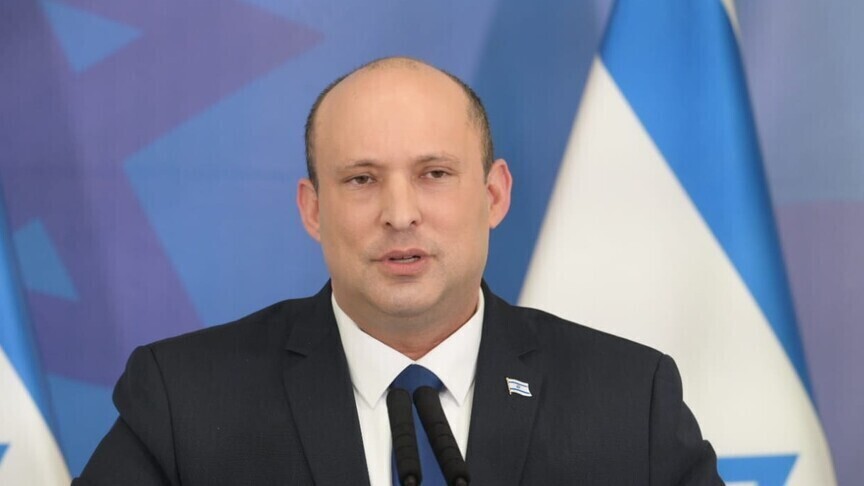
Israel's Channel 12 said on Thursday that Ma'a party head Naftali Bennett is pushing to form a unity government with Benjamin Netanyahu, to be headed first by Gadi Eisenkot, and rejects forming a government that relies on Arab parties.
Citing informed political sources it did not name, the channel added that Bennett's position sparked disputes within the "change camp", which includes his party and other parties seeking to end Netanyahu's rule, over options for forming the next government.
Bennett's position and the disputes within the camp
The camp includes the Yashar party led by Eisenkot, who has been tasked with forming the government, Ma'a led by Bennett, Yisrael Beytenu led by Avigdor Liberman, and the Democrats led by Yair Golan.
According to Channel 12, Bennett told the change camp's leaders during a meeting on Wednesday that he opposes forming a government based on the votes of Arab parties, warning of the political repercussions of that for Israel. Instead, Bennett proposed continuing efforts to form a unity government with Netanyahu's Likud party, on the basis of rotating its premiership, with Eisenkot taking the post first.
Responding to the proposal, Yair Lapid, the number two in the Ma'a party, said Bennett could continue his attempts to reach an agreement with Netanyahu, but expressed distrust of Netanyahu and ruled out the success of these efforts.
The channel noted that the disputes extend inside some of the camp's parties, over the need to exhaust the option of a unity government and negotiate with the Haredi (ultra-Orthodox) parties before resorting to forming a minority government.
Election results and the options on the table
The disputes come as neither of the two rival camps holds a parliamentary majority that would allow it to form a government on its own, following the legislative elections held on October 27. The elections gave Netanyahu's camp 53 seats, versus 48 for the change camp, while the Arab parties won 19 seats out of 120 in the Knesset (parliament).
Forming a government requires securing the confidence of at least 61 lawmakers, which makes the support of the Arab parties one of the options available to the change camp to pass the required majority without allying with Netanyahu.
The options before Eisenkot include forming a minority government comprising the change camp, which holds 48 seats, with outside support from the Arab parties, which hold 19 seats. In theory, this option would secure the support of 67 Knesset members, without the Arab parties necessarily participating in the government itself.
On November 11, Israeli Democrats leader Yair Golan called for talks with the Arab parties to discuss a partnership that would allow forming an alternative government to Netanyahu's. However, his calls were rejected by Liberman, one of the "change camp" partners, who pledged not to take part in a government that includes the Arab parties or relies on their support.
The channel said Eisenkot may put the minority government to a vote in the Knesset after exhausting the other options, which would allow the change camp to say it tried every possible path to form the government.
Negotiations and the constitutional deadline
In a related context, Eisenkot's and Netanyahu's teams agreed to hold a new negotiation meeting next Sunday, while the two sides exchanged accusations over not making serious efforts to reach an agreement, according to the same channel. On Wednesday, Bennett met Netanyahu in a meeting that lasted about three hours, presented as a security briefing but which also included political talks, according to the channel.
On November 8, Israeli President Isaac Herzog tasked Eisenkot with forming the new government, after he received the recommendations of 67 lawmakers, versus 46 for Netanyahu, while 7 lawmakers abstained from recommending any candidate.
Eisenkot has a 28-day deadline to form the government, ending on December 6, with the possibility of extending it by an additional 14 days, before moving to other options if he fails.
Source: Anadolu Agency
Comments (0)