

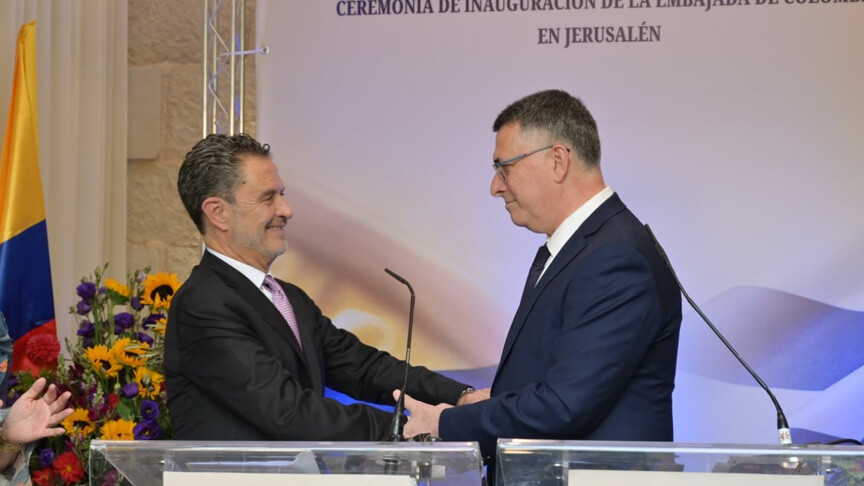
Colombia opened its embassy in the occupied city of Jerusalem on Wednesday, becoming the tenth country to decide to relocate its embassy to the city, a move described by sources as contrary to international resolutions. The opening ceremony was attended by Israeli Foreign Minister Gideon Sa'ar, his Colombian counterpart Omar Bola Escobar, and the mayor of West Jerusalem, Moshe Lion.
For his part, Mayor Moshe Lion pointed out that Colombia has become the tenth country to relocate its embassy to West Jerusalem. Colombia precedes the United States, Guatemala, Honduras, Kosovo, Papua New Guinea, Paraguay, Fiji, Nauru, and the breakaway region of Somaliland, which have relocated their embassies to Jerusalem or opened new embassies in the city.
The vast majority of countries oppose relocating their embassies to Jerusalem, given the lack of international recognition of Israel's 1980 annexation of East Jerusalem, which it occupied in 1967, and which Palestinians insist should be the capital of their future state. Israel claims that the city of Jerusalem, in both its eastern and western parts, is its capital, despite widespread international rejection of this claim.
Israel is making intensive efforts to repair its foreign relations, amid global public and official anger over the genocide it is committing with American support in the Gaza Strip since October 8, 2023. In 2017, during his first term, US President Donald Trump considered Jerusalem, in both its eastern and western parts, as the alleged capital of Israel and decided to relocate his country's embassy from Tel Aviv to Jerusalem.
In response to Trump's move, the UN General Assembly adopted a resolution in the same year stating that any decisions or actions aimed at changing the character or status of Jerusalem have no legal effect and are considered null and void. Israel was established in 1948 on Palestinian lands occupied by armed Zionist gangs that committed massacres and displaced no less than 750,000 people, and it refuses to withdraw and establish the Palestinian state stipulated in UN resolutions.
Of the 193 member states of the United Nations, 160 recognize the State of Palestine, which is a member of more than a hundred international organizations and treaties, according to the Palestinian Ministry of Foreign Affairs. Israel and its ally, the United States, reject these recognitions, and Washington uses its veto power in the Security Council to prevent Palestine from gaining full membership, instead of the "non-member observer state" status that has existed since 2012.
Source: Anadolu Agency
Comments (0)