

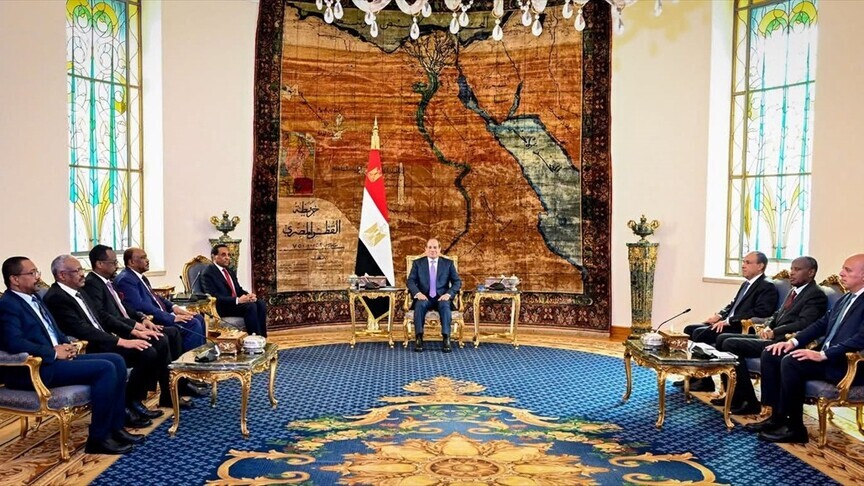
Egypt reaffirmed on Tuesday its readiness to take all measures and procedures provided for by the joint defense agreement with Sudan, while holding to “red lines” related to Sudan's sovereignty, territorial unity and institutions.
The Egyptian position came in a joint statement issued at the conclusion of a working visit by Sudanese Prime Minister Kamil Idris to Cairo, during which he met President Abdel Fattah el-Sisi and Prime Minister Mostafa Madbouly. The statement did not specify the nature of the measures Egypt may take, and did not announce the military activation of the agreement.
Details of the Joint Statement
According to the statement, Cairo reaffirmed the direct link between Egypt's and Sudan's national security, its rejection of establishing or recognizing any parallel entities in Sudan, and its readiness to take the necessary measures to ensure these red lines are not crossed.
The joint statement stressed “Egypt's full readiness to take all necessary measures and procedures permitted by international law and the joint defense agreement between the two brotherly countries, to support Sudan and ensure that these red lines are not violated or crossed.”
In the same statement, the two countries condemned the targeting of civilians and infrastructure in Sudan by what they described as “rebel militias” (the Rapid Support Forces), particularly electricity stations and water facilities, with drones that they said were launched from a neighboring country, without naming it. They also reaffirmed their support for Sudanese national institutions, led by the armed forces.
Key Provisions of the Agreement
Egypt and Sudan signed the joint defense agreement on 15 July 1976, within the framework of the two countries' effort to strengthen military and security coordination and confront regional challenges. The agreement contains 8 articles defining the obligations of both countries, the mechanisms of military cooperation, and the bodies responsible for implementing it.
Article 1 is the most prominent from a military standpoint, as it stipulates that any armed aggression against either state or its armed forces is considered aggression against both. It obliges each state to promptly assist the other if attacked and to take all necessary measures immediately, including “using the armed forces to deter and repel aggression.”
Thus, the measures provided for are not limited to military support or security coordination, but also include the possibility of using armed forces against armed aggression, subject to the conditions set out therein. According to information in the source, the text does not automatically mean that the joint defense provisions apply to the internal war ongoing in Sudan, and Cairo's announcement of its readiness to take measures under the agreement does not in itself constitute a decision to intervene militarily.
Article 2 provides for the exchange of information and consultation in the event of a sudden aggression or a sudden situation feared to be serious, and for moving toward unifying the two countries' plans and movements. Article 3 provides for coordinating plans and methods for developing the armed forces of both countries, in a way that ensures the absorption of the most advanced modern weapons.
Article 4 provides for establishing bodies to ensure its implementation, most notably the Joint Defense Council and the Joint General Staff. Under Article 5, the Joint Defense Council is composed of the foreign and defense ministers of both countries, serves as the highest authority over the Joint General Staff, and meets periodically every 6 months, alternating between Cairo and Khartoum, or whenever circumstances require, at the discretion of either state.
Article 6 provides for the formation of the Joint General Staff from the chiefs of staff of the armed forces of both countries and an equal number of staff officers from each, meeting periodically every 3 months, or whenever needed at the request of either chief of staff.
Article 7 sets the agreement's duration at 25 years, renewing automatically for 5-year periods unless either state notifies the other of its wish to withdraw one year before its term ends. Article 8, the final article, provides for ratification in accordance with the constitutional procedures of both countries, the exchange of ratification documents at the Sudanese Ministry of Foreign Affairs, and entry into force from the date of that exchange.
The Agreement's Course Since Signing
The first years after the agreement was signed saw practical steps to implement its provisions. From 7 to 10 September 1976, the Joint Defense Council held a meeting in Cairo. In November of the same year, the Joint General Staff held its first meeting in Khartoum, during which an agreement to support military cooperation between the two countries was signed. The body held its second meeting in Cairo from 23 to 25 April 1977.
On 12 October 1982, the Charter of Military Integration between Egypt and Sudan was announced, affirming the importance of implementing a single defense and security strategy. Fifteen days after the charter was announced, then Sudanese President Jaafar Nimeiry said the declaration aimed to merge the military theaters of operations of the two countries from north to south, without Egyptian confirmation. His remarks raised concerns in Sudanese circles about possible Egyptian interference in the country's internal affairs, amid calls to cancel the joint defense agreement.
On 21 February 1987, then Sudanese Prime Minister Sadiq al-Mahdi and his Egyptian counterpart Atef Sedki signed the “Charter of Fraternity,” which did not explicitly include any provision on canceling the agreement. On 2 April 1989, Mahdi announced the cancellation of the agreement concluded under Nimeiry, according to Sudanese press reports, without any similar Egyptian announcement.
In the years following Ethiopia's start of construction of the Grand Ethiopian Renaissance Dam in 2011, military cooperation between Egypt and Sudan grew. In November 2011, the two countries agreed, during military talks in Khartoum, to form joint forces and conduct border patrols to combat terrorism and cross-border crime. In March 2021, the armies of the two countries signed a military cooperation agreement aimed at “achieving the national security of Sudan and Egypt,” which covered cooperation to confront threats to the national security of both countries, meeting the Sudanese army's needs in training and technical expertise, and joint coordination to protect borders. Although the fields of this cooperation intersect with the provisions of the 1976 agreement, it was not accompanied by an explicit announcement of reactivating it.
Recent Positions
On 18 December 2025, the joint defense agreement returned to the forefront of Egyptian official positions, following talks between Sisi and Burhan in Cairo. The Egyptian presidency stated at the time that “there are red lines that cannot be allowed to be crossed or compromised, given that this directly affects Egypt's national security, which is directly linked to Sudan's national security,” affirming its country's right to take the necessary measures and procedures permitted by international law and the joint defense agreement.
On the same day, Sudanese Undersecretary of Foreign Affairs Muawia Osman Khalid said in a statement that Sisi and Burhan had called during their meeting for activating the agreement in light of current challenges. Also, the head of Egypt's State Information Service, Diaa Rashwan, responding to what had been raised about canceling the agreement, affirmed that it remains in force and covers confronting any dangers or threats to the security of both countries. The call for activation was not followed by an official announcement of reactivating its specified military mechanisms or of taking military measures under it.
The renewed discussion of the agreement comes amid the continuing war between the Sudanese army and the Rapid Support Forces since April 2023, and the security and military challenges it imposes on both countries.
However, the Egyptian position announced so far remains within the framework of affirming readiness to take those measures, without announcing their nature or beginning their military implementation.
Source: Anadolu Agency
Comments (0)