

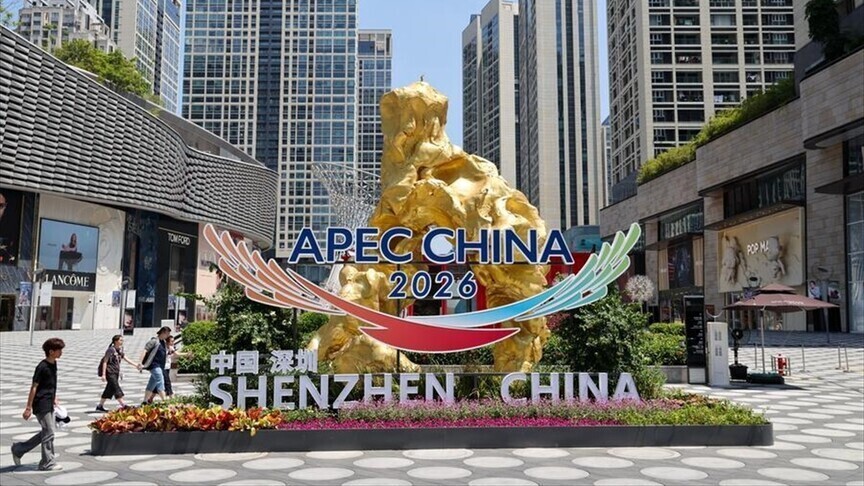
All eyes are on the Chinese city of Shenzhen, where the leaders of the United States, Russia and China meet in an unprecedented three-way meeting on Thursday, amid Ukrainian and European fears of understandings that could redraw the balance of international influence without their participation.
81 years ago, in February 1945, the city of Yalta on the Crimean peninsula hosted a US-British-Soviet summit to discuss arrangements for post-World War II Europe. As the new three-way summit approaches, fears are growing that the Yalta scenario could be repeated, amid international efforts to end the Russia-Ukraine war.
However, experts speaking to Anadolu rule out a repeat of the Yalta scenario, and believe that the Ukrainian crisis, the Iranian file, nuclear armament, energy security and technological competition will top the summit's talks.
Background to the comparison
Since February 24, 2022, Russia has been waging a war on Ukraine, and it makes ending it conditional on Kyiv giving up joining Western military blocs, which Kyiv rejects and considers interference in its affairs. Europe stands with Ukraine, while Washington moves at close distances from Moscow and leads mediation efforts.
In late October, Ukrainian President Volodymyr Zelensky said: "It is not yet clear what China, Russia and the United States may discuss (...) We absolutely do not want this to turn into Yalta 2 or 3 or 4, with a redistribution of spheres of influence." Zelensky repeated these fears about a week ago.
In statements to the channel ARD, German President Frank-Walter Steinmeier said his Chinese counterpart stressed that the conflict in Ukraine is a European one, and that Europeans must be present at the negotiating table. Kyiv and European countries oppose any understandings that might impose changes affecting the continent without its participation, and demand a ceasefire before discussing the terms of a settlement.
Reactions and expert opinions
On Tuesday, the Kremlin rejected comparing the upcoming summit to the Yalta conference, stressing that it will not decide the fate of other countries, and considered that "all comparisons with Yalta are merely political analyses that have nothing to do with reality."
Nabil Mikhail, professor of political science at George Washington University, told Anadolu that comparing the summit to the Yalta conference is "historically inaccurate," explaining that Yalta came in the context of arrangements for the end of World War II, unlike the current reality, which is not witnessing a full-scale war of the same magnitude.
For his part, researcher Dimitri Bridge said the similarities between the two summits are superficial and the differences are greater, saying that "the Yalta comparison is a political tool more than a description of what is happening," explaining that Kyiv uses it to fortify its position in advance. He added that the Yalta decisions were "enforceable by force, whereas today no country has the ability to impose its will alone."
Moroccan international economics expert Rachid Sari agrees with him, and believes that China does not want to appear as the party imposing a solution on Europe.
Issues on the table and possible outcomes
On Monday, Kremlin foreign policy adviser Yuri Ushakov confirmed that the three-way meeting will be held on the sidelines of the Asia-Pacific Economic Cooperation (APEC) summit in Shenzhen on Wednesday and Thursday. The Chinese Foreign Ministry announced that the summit will be held to discuss strategic stability and nuclear arms control.
Sari expects the talks to be dominated by energy security and technological competition, nuclear armament, the Ukrainian crisis and the Iranian file.
Mikhail expects the summit to help calm hotspots of tension, but rules out that it will reach long-term strategic deals. As for Bridge, he rules out reaching a grand deal, and noted that China refuses to put the Ukrainian crisis on the agenda while Moscow wants to discuss it.
Source: Anadolu Agency
Comments (0)