

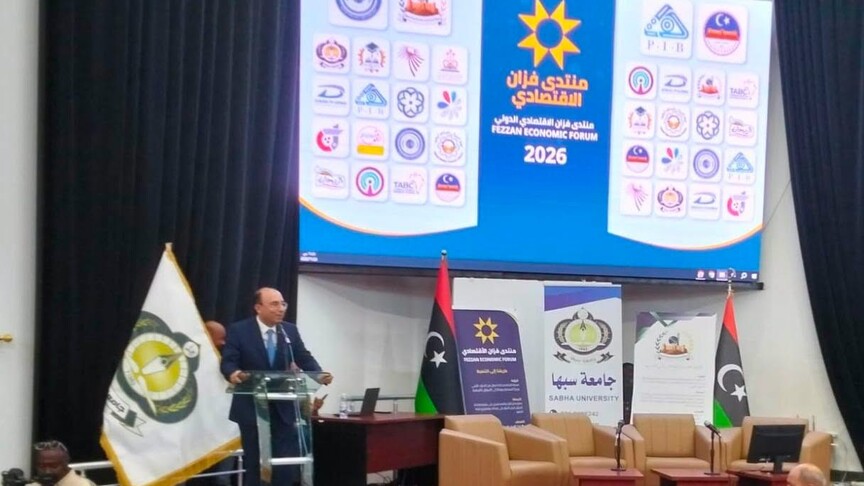
The first edition of the Fezzan International Economic Forum opens on Tuesday in the city of Sabha in southern Libya, with Tunisian participation. Its activities will continue until Thursday.
Tunisian Participation Aims to Reach African Markets
Tunisian participation aims to develop partnerships in infrastructure, energy, transport and logistics, in order to reach markets in sub-Saharan Africa. The organizers chose the Tunisian African Business Council, which brings together Tunisian businesspeople interested in investing on the continent, as guest of honour of the forum, which Sabha hosts south of the capital, Tripoli.
The council announced that a Tunisian economic delegation will take part in the forum from 24 to 26 November of this year, aiming to present Tunisian skills and expertise and to explore investment and partnership opportunities in southern Libya. The delegation includes representatives of the construction, infrastructure, energy, industry, agriculture and services sectors. A workshop is scheduled to support cooperation between Tunisian and Libyan institutions.
Trade Exchange Amid Signs of Economic Recovery
Tunisian participation comes amid signs of a revival in economic activity between the two neighbouring countries. In the first nine months of this year, their trade exchange reached about $833.3 million, according to the Tunisian Export Promotion Center (governmental), which announced the figure on 10 November.
The president of the Tunisian African Business Council, Anis al-Jaziri, said that the Chamber of Commerce, Industry and Agriculture in Sabha is organizing the first edition of the forum, at which the council is guest of honour, with delegations from African countries neighbouring Libya taking part. In a statement to Anadolu, he explained that the forum seeks to make Sabha, which he described as the capital of southern Libya, a logistics hub and a gateway to markets in sub-Saharan Africa, particularly Chad, Niger and Mali, and extending to Nigeria, one of the continent's largest markets.
He added that the proposed concept is to establish something similar to a dry port in Sabha to serve Tunisian industry and benefit from Libyan commercial experience. A dry port is an inland terminal located away from the coast, used for transporting goods and clearing them through customs, and directly connected to seaports by railway lines or highways.
Role of Libyan Traders and Product Distribution
Al-Jaziri continued that Libyan traders, by virtue of their historical experience, know the routes to reach and enter sub-Saharan African markets. He said the Tunisian side can deliver its industrial products to the logistics zone in Sabha, while its Libyan counterpart takes charge of distributing Tunisian and Libyan products, amid the growing presence of Libyan industry in southern Saharan markets.
He said this approach includes investments in infrastructure, energy and logistics services, and added that the forum will focus on presenting projects in these fields, alongside transport, to make Sabha a transit hub for markets south of the Sahara.
Forum Objectives and Investment Opportunities
According to Masadeq al-Zaitari, head of the forum's organizing committee, speaking to Anadolu, the forum is “a platform that showcases southern Libya as a logistics and commercial gateway between Mediterranean ports and the depths of Africa.” He described Tunisia as a “natural partner” because of its expertise in food, processing industries, services and logistics.
He added that Libya, for its part, has the location and resources, and that its market is witnessing demand in these fields. He said the forum includes bilateral meetings between businesspeople, and presentations of investment opportunities in agriculture, industry, solar energy and transit trade, along with recommendations to be submitted to the legislative and executive authorities.
Al-Zaitari described the trade exchange between the two countries reaching 2.5 billion dinars over nine months as an encouraging figure that reflects the revival of economic activity between them. He added that the forum seeks to develop these exchanges to include joint production partnerships, joint investments and supply chains.
On the opportunities for Tunisians amid international competition, he said they benefit from geographic proximity, shared language and culture, as well as their knowledge of the Libyan market. He considered that the most prominent opportunities include the food and agricultural industries, medical and educational services, contracting and construction materials, logistics services, transit trade towards Africa, and solar energy.
Al-Zaitari believes that the entry of Tunisian investors into the Libyan market, whose appeal is reflected in international competition, through partnerships with Libyan investors, makes it possible to establish joint projects and manufacture locally. He stressed that the forum's organizers seek to make Fezzan a gateway to Africa, with Tunisia as a key partner in this direction.
Sabha is the historical and administrative capital of the Fezzan region in south-western Libya.
A Tunisian Academic's View on Reconstruction and Investment
Tunisian academic Abdelmajid al-Jammal told Anadolu that the forum falls within efforts to rebuild Libya. He added that the Chamber of Commerce, Industry and Agriculture in Sabha and the city's municipal council are jointly organizing the forum. He noted that Sabha lies in the heart of the Libyan desert and features an domestic airport and vast spaces.
He continued that the Libya Development and Reconstruction Fund, supervised by Khalifa Haftar (deputy commander of the forces of eastern Libya / the “Libyan National Army”), is the main financier of reconstruction in the south. He added that reconstruction work in Libya has been proceeding rapidly for years.
Al-Jammal described Tunisia's participation as guest of honour in the first edition as a “courageous step,” and pointed to the many investment opportunities in rebuilding, construction and agriculture. He considered that the volume of trade between Tunisia and Libya has reached a significant figure, but remains modest compared with the trade between Libya and Turkey, which far exceeds it.
He believes that education and health are among the promising fields for partnership with Tunisia. On education, he noted that the University of Fezzan has announced its need for holders of master's and doctoral degrees in several specialties, including history, archaeology, media, artificial intelligence, medicine and engineering.
He pointed to the growing investment opportunities in Libya, which several countries compete for, including Turkey, France, Italy, the United States and Egypt. On how to develop investment between Tunisia and Libya, al-Jammal said it requires political decisions, boldness from investors and a willingness to take risks.
He added that whoever travels to the heart of the desert must adapt to its realities and not expect to stay in luxury hotels. He concluded that security is available to those who coordinate with official authorities, and that travel between eastern and western Libya takes place without problems.
Source: Anadolu Agency
Comments (0)