

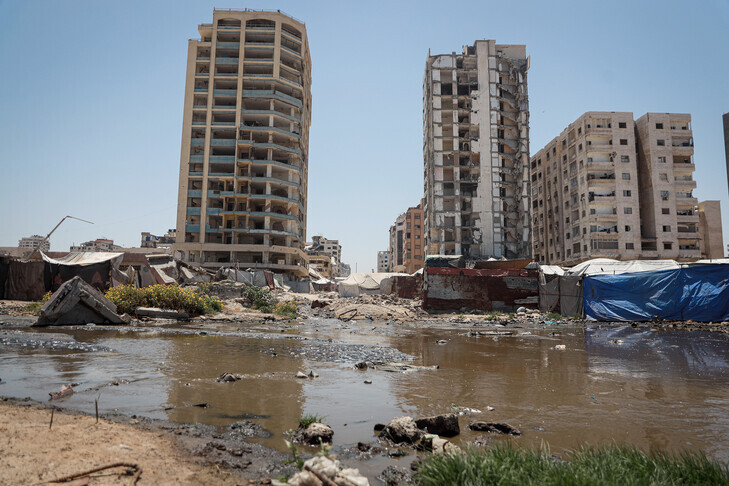
The Ministry of Health in the Gaza Strip warned on Sunday of an "alarming and unusual" seasonal rise in the number of meningitis cases, and called for urgent international intervention to contain the risk of disease outbreaks.
In a statement, the ministry said: "The health system is facing serious epidemiological challenges, with a notable, alarming and seasonally unusual rise in the number of meningitis cases, particularly viral meningitis."
Causes of the rise and the ministry's warnings
The ministry added that this rise is closely linked to "the ongoing environmental deterioration and damage to essential infrastructure, including sewage networks and the environmental sanitation system."
It explained that damage to sewage networks, the breakdown of the treatment system, and the mixing of drinking water sources with wastewater during rainfall have pushed "the epidemiological curve upward in a number of areas of the Strip."
It warned that the number of cases will continue to rise "if urgent and effective measures are not taken," which poses "a growing health risk whose impact is concentrated particularly on children and the most vulnerable groups."
The ministry held Israel directly responsible for the damage to water and sewage networks, and for the restrictions on the entry of maintenance and sterilization materials and fuel, considering that these create conditions for the transmission of pathogens and worsen infections.
Calls for international intervention
The ministry called on the international community and UN organizations to intervene urgently to facilitate the entry of the equipment and materials needed to repair water and sewage networks, and to provide supplies for water treatment and sterilization.
It also called on the World Health Organization, the United Nations Children's Fund (UNICEF) and health partners to provide the laboratory and diagnostic supplies, medicines and treatments needed to handle the cases.
It stressed the need to secure fuel to operate water desalination plants and to pump and treat wastewater, and to prevent its accumulation or overflow in shelters and residential areas. It called for an increase in disinfection and sterilization materials and personal hygiene supplies for displaced families, to limit the spread of infection.
It affirmed that containing the risk of epidemic outbreaks and protecting infants and groups most at risk of complications require immediate international intervention and sustained supplies before the health situation worsens and becomes difficult to control.
UN figures and reports
The ministry did not state the number of cases. The UN Office for the Coordination of Humanitarian Affairs (OCHA) reported on 13 November that 413 probable meningitis cases were recorded in the Gaza Strip, including 294 cases of viral meningitis and 119 of bacterial meningitis, between 27 September and 31 October.
The office said 68 percent of the cases were recorded in Gaza governorate, while infants under one year old made up 77 percent of the 202 cases documented individually as of 5 November.
On 19 November, the Gaza Strip Municipalities Union announced that Israel had destroyed more than 700,000 linear meters of sewage networks and put 85 percent of municipal vehicles and equipment out of service since October 2023.
An OCHA report issued on 18 November stated that 45 percent of the households covered by an assessment conducted in October reported the presence of sewage water or contaminated sediment within 10 meters of their shelters.
Context of conditions in the Strip
This comes amid deteriorating health and environmental conditions in the Gaza Strip, due to the widespread destruction left by Israel's war of genocide on hospitals, health facilities, and water and sewage networks, in addition to shortages of medicines, medical supplies and fuel.
Since October 2023, Israel, with US support, has been waging a genocidal war in Gaza, which has left more than 74,000 Palestinians dead and over 176,000 injured, most of them children and women, as well as destruction affecting 90 percent of infrastructure.
Despite a ceasefire agreement taking effect on 10 October 2025, Israel continues its aggression on the Strip, which has killed 1,671 Palestinians and injured 6,062 others.
Source: Anadolu Agency
Comments (0)