

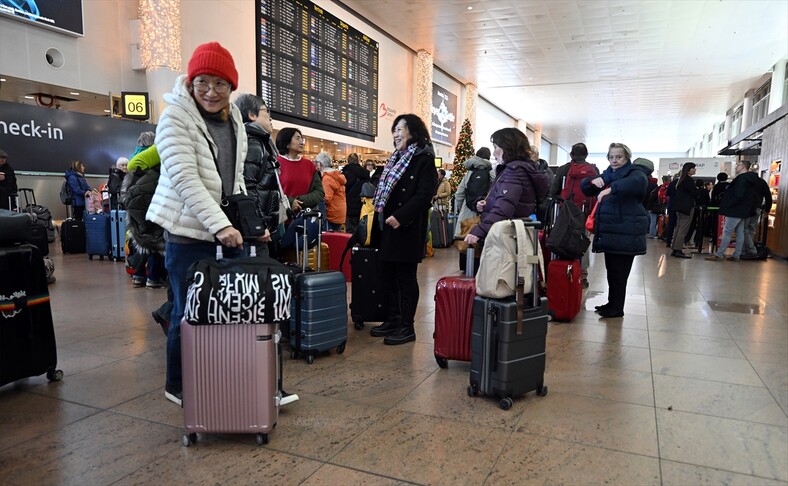
Air Transport and Public Services Disrupted
Workers in Belgium carried out a one-day general strike on Monday to protest government austerity policies. The strike caused widespread disruption to public services and mass transit and led to flight cancellations at the country's airports. The strike was called by Belgium's largest trade unions, "CSC", "FGTB" and "Cinove", in protest against cuts the federal government plans to make to social spending and the decline in workers' purchasing power.
The strike caused wide disruption to public and private sector services across the country, bringing daily life to an almost complete standstill. No flights were recorded in Belgian airspace between 7 a.m. and 9 p.m., because staff of "Skeyes", the company responsible for monitoring Belgian airspace, took part in the strike.
In the same context, air traffic control services and arrival and departure flights at Brussels Airport stopped during the same period, while all scheduled flights at Charleroi Airport were cancelled for the entire day.
Public Transport, Municipal and Educational Services Disrupted
Most metro, bus and tram services in Brussels could not operate, as workers at the city's public transport company joined the strike. The disruption spread across the country, with public transport staff in the Flanders and Wallonia regions also joining the strike.
Classes could not be held at some schools because a large number of teachers took part in the strike. Waste collection, day-care centres and a number of administrative procedures were also disrupted, as municipal employees took part widely.
March in Brussels
As part of the strike, thousands of people demonstrated in the capital, Brussels, to protest government policies. Protesters gathered in front of Brussels-North railway station, wearing their union jackets in red, green and blue. Demonstrators chanted slogans against the government and raised protest banners before setting off on a march that covered several kilometres.
Roads in central Brussels were closed to traffic throughout the day because of the march.
Union Demands and Budget Negotiations
The strike comes as budget negotiations continue within the governing coalition led by Prime Minister Bart De Wever. The unions believe the measures the government plans to take to reduce the budget deficit would weaken workers' purchasing power and erode their social rights.
The unions are calling on the federal government to amend the measures aimed at reducing the budget deficit, take steps to protect purchasing power, maintain the system of automatic wage indexation and social benefits in line with rising living costs, and abandon the cuts to public service allocations. The alternative budget plan proposed by the unions includes imposing higher taxes on capital gains and strengthening the fight against tax evasion.
Source: Anadolu Agency
Comments (0)