

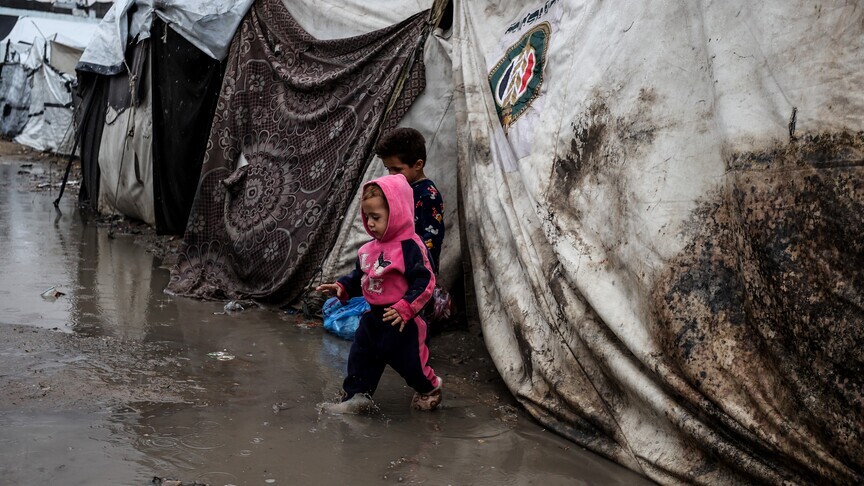
Flooding of Camps and the Siege
The "Hamas" movement confirmed on Sunday that the flooding of displaced camps and residential neighborhoods in the Gaza Strip by rainwater is a "direct result" of the continued Israeli siege and Tel Aviv's reneging on its commitments under the ceasefire agreement. Since Friday evening, a low-pressure system accompanied by heavy rains and strong winds has struck Gaza, resulting in the flooding of more than 70,000 tents and the collapse of four homes and dozens of walls damaged by the Israeli genocide war, according to official data.
Continued Bombing and Aid Blockade
Hamas pointed out in a statement the "catastrophic effects of the low-pressure system witnessed in the Gaza Strip, and the accompanying flooding of displaced camps and residential neighborhoods and damage to buildings". It added that what happened is a "direct result of the continued siege policy pursued by the occupation government headed by war criminal (Benjamin) Netanyahu, and its prevention of implementing the humanitarian protocol stipulated in the ceasefire agreement". Despite the ceasefire agreement announced since October 10, 2025, Israel continues its genocide war in Gaza through daily bombing that has killed more than 1,600 Palestinians and injured more than 5,700.
Catastrophic Humanitarian Conditions
It also prevents the entry of agreed quantities of food, medicines, medical supplies, shelter materials, and prefabricated homes into Gaza, where approximately 2.4 million Palestinians, including 2.15 million displaced persons, live in catastrophic conditions. The movement stressed that the suffering of hundreds of thousands of displaced persons is exacerbated under Israel's continued obstruction of the entry of urgent shelter supplies, including mobile homes (caravans), repair and heating materials, and civil defense equipment. It continued that displaced persons "are living extremely harsh humanitarian conditions inside damaged shelters and tents".
International Appeals and UN Statistics
It criticized what it termed "the faint positions of the so-called Peace Council and its Executive Director (Nikolay) Mladenov regarding the occupation's violations of the ceasefire agreement". It considered that they "constitute a cover for the continuation of these violations, which necessitates the Council bearing its humanitarian and moral responsibilities and working to halt the deterioration of the situation in the Gaza Strip". It called on the "Peace Council" to take serious steps to compel the Israeli occupation to fulfill its commitments and stop its continuous violations of the ceasefire agreement. It also called on mediators to "play a more effective role in ensuring the full implementation of the humanitarian protocol (of the agreement), and the flow of aid and shelter and relief needs". It urged mediators and guarantors to "exert real pressure on the occupation to stop its prevention of the entry of the National Committee for the Management of the Gaza Strip into the Strip, and enable it to exercise its national responsibilities immediately". It appealed to Arab and Islamic countries to "break the siege imposed on the Strip and ensure the entry of basic needs for shelter, medicine, and food". Last August, the Gaza Government Media Office stated that more than 2.15 million displaced persons are living tragic conditions, including approximately 867,000 in dilapidated tents, and more than one million inside shelters. On Thursday, the United Nations Relief and Works Agency for Palestine Refugees in the Near East (UNRWA) said that 1.98 million people, or approximately 94 percent of citizens in Gaza, need shelter and non-food assistance, according to surveys conducted between June 14 and 28. It added that the assessment also showed that "58 percent of the sector's population faces critical or catastrophic shelter needs". It reported the existence of "a severe deficit in shelter conditions or lack of access to basic services and non-food assistance". In a report published in mid-October 2026, the UN Office for the Coordination of Humanitarian Affairs (OCHA) warned that approximately 950,000 Palestinians are living in displacement sites exposed to medium or high flood risks, including more than 400,000 in high-risk areas. It added that approximately 294,000 families need shelter assistance during the winter, while available supplies are insufficient to provide partial assistance to approximately 52,000 families, equivalent to 18 percent of the total estimated needs.
Source: Anadolu Agency
Comments (0)