

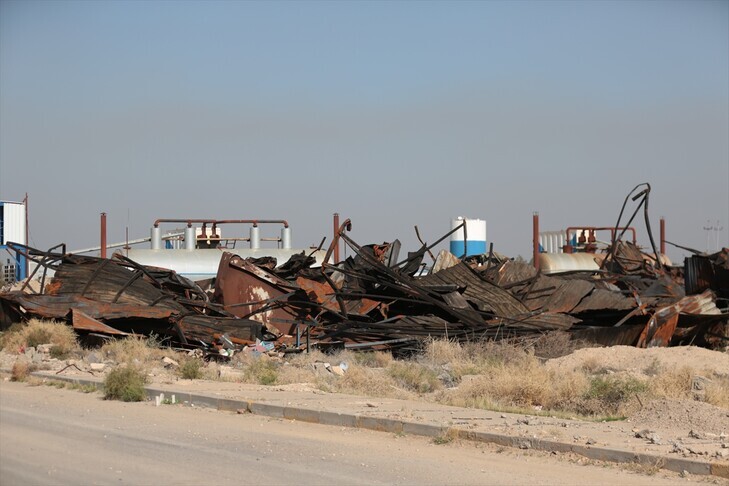
The head of the Iraqi Security Media Cell, General Saad Maan, announced on Tuesday that more than 18 hoses had been detected being used to fill tankers with oil and smuggle it from the Safiya field north of the Rabia district, in the province of Nineveh in the country's north-west. He accused governors of granting approvals to export oil abroad in violation of the law and the constitution.
Details of the Monitoring
Maan said in a statement to "Al-Iraqiya News" channel, relayed by the Iraqi News Agency (INA), that "government measures are based on facts and realities, and do not target a specific geographic area or party."
He noted that "the investigative committee detected more than 18 hoses used to fill oil into tankers and smuggle it from the Safiya field north of Rabia, although it is supposed to have been closed for a long time." He stressed that "the smuggling operations are documented with photographs and evidence, in addition to the detection of other smuggling operations in the Jaspa field."
He added that "the Anti-Oil Smuggling Law No. 41 of 2008 includes penalties for anyone who sabotages oil facilities, including pipelines and tanks, for smuggling purposes."
Decisions to Dismiss Officials and Refer Violations
Maan's remarks came after al-Zaidi earlier on Tuesday ordered the dismissal and relief of 8 security and administrative officials, including the operations commanders and police chiefs of Kirkuk and the head of the Border Crossings Authority, after reviewing the report of the investigative committee into the oil smuggling file at the "North Oil Company" affiliated with the federal Ministry of Oil.
The decisions included referring violations to the judiciary, restricting the issuance of crude oil and oil product export approvals in the Kurdistan Region to the federal Ministry of Oil, and directing the Border Crossings Authority to take over all border crossings in the region.
Regarding the border crossings, Maan explained that "the crossings represent the official gateway of the country and are linked to its sovereignty, which requires placing them under central administration," stressing that "government measures serve the interests of the people of the Kurdistan Region and all citizens in Iraq's provinces."
Background to the Baghdad-Erbil Disputes
There are long-standing disputes between Baghdad and Erbil over the management of oil fields and border crossings, and over powers related to oil production, export and revenue collection. In May 2022, the North Oil Company accused the Kurdistan Regional Government of seizing a number of its oil fields and wells, including Khurmala, Avana, Safiya and Kormor, while the regional government at the time denied accusations of controlling wells in the Bai Hassan and Dawood fields in Kirkuk province.
In September last year, the federal government and the Kurdistan Regional Government reached a security agreement of around 17 articles, which included strengthening border control, closing informal crossings used for smuggling, and intensifying security and intelligence coordination.
In the same context, Kurdistan Region Interior Minister Rebar Ahmed said on Tuesday that the regional government is ready to cooperate with Baghdad on files concerning corruption, oil smuggling, and the handover of suspects and wanted persons, based on the constitution and agreements signed between the two sides, according to the Iraqi News Agency (INA).
Source: Anadolu Agency
Comments (0)