

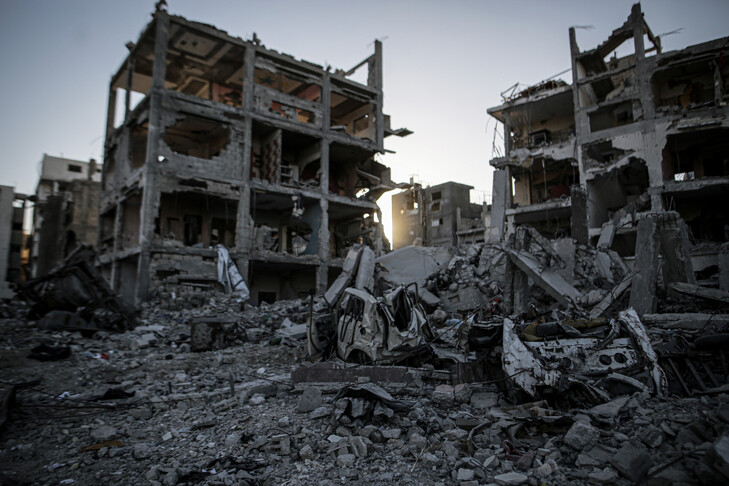
In recent days, the Israeli army has adopted a new method of blowing up Palestinian homes and facilities in various areas of the Gaza Strip, by dropping boxes loaded with highly explosive materials using "quadcopter" drones. The boxes are detonated remotely, causing huge explosions and widespread destruction to buildings and their surroundings.
What Residents and Eyewitnesses Observed
For about a week, residents and eyewitnesses have observed Israeli drones dropping boxes containing several kilograms of explosives over or around Palestinian homes and buildings, near areas controlled by the Israeli army within what is known as the "Yellow Line." These operations were observed in several areas, including east of the Zeitoun and Tuffah neighborhoods in Gaza City, and the eastern areas of Deir al-Balah and the Bureij camp in central Gaza.
Circulating footage documented by Palestinian activists showed Israeli drones carrying explosive boxes and dropping them onto the rooftops of homes, before detonating them remotely at a later point, destroying the targeted buildings and causing widespread damage to neighboring structures.
Displacement and Escalating Operations
The explosions have sparked fear and panic among residents, prompting many of them to flee nearby areas. Local sources documented on Friday the displacement of dozens of Palestinians from the Zeitoun neighborhood east of Gaza City, fearing their homes would be blown up.
According to the same sources, detonation operations escalated in recent days. They reported that on Monday morning, Israeli drones dropped explosive boxes and detonated them in the area of the Wadi Gaza bridge on Salah al-Din Street, and north of the Bureij and Nuseirat camps. The sources indicated that the operation was repeated at least seven times, causing huge explosions and great destruction.
The Israeli army had previously used the same method on 10 November, when it blew up two homes that had been evacuated beforehand, east of the Maghazi camp in central Gaza, using explosive boxes dropped by "quadcopter" drones, according to local sources who spoke to Anadolu. In the city of Khan Younis in the south of the Strip, the Israeli army carried out four detonation and demolition operations in the same manner around Dar al-Salam Hospital northeast of the city, while the eastern areas of the Zeitoun neighborhood witnessed similar detonations on Friday.
Ceasefire Context and War Toll
This method comes amid the continued destruction of Palestinian buildings since the ceasefire agreement took effect on 10 October 2025. The demolitions have not been limited to air and artillery strikes but have included remotely controlled detonations and the use of bulldozers and military vehicles to demolish buildings and level them to the ground. Since the start of the war, demolitions have relied on several means, chiefly aerial bombardment with heavy bombs, artillery shelling, planting explosive devices inside or around buildings and detonating them remotely, in addition to using heavy military bulldozers to raze residential neighborhoods and level them to the ground.
Since the agreement took effect, demolition, razing and detonation operations have not stopped in areas under Israeli military control, known as the "Yellow Line areas," which heightens Palestinians' fears of losing what remains of their homes and limits the possibility of their return. Detonations were previously carried out using old booby-trapped military vehicles driven between buildings in neighborhoods near areas under Israeli army control across the Gaza Strip, causing huge explosions that destroy entire residential blocks.
The UN Office for the Coordination of Humanitarian Affairs (OCHA), in its report on the first month of the agreement, documented continued reports of daily detonations of residential buildings, alongside continued restrictions on Palestinians' access to those areas.
These developments come amid continued Israeli violations of the agreement. As of Sunday, these violations had killed 1,647 Palestinians and wounded 5,969 others, according to the latest toll announced by the Gaza Health Ministry.
Since 8 October 2023, Israel, with US support, has waged a war on the Gaza Strip, described by UN and human rights bodies as genocide, which has killed more than 74,000 Palestinians and wounded more than 176,000, most of them children and women, according to data from the Strip's health authorities. The war has left destruction affecting about 90 percent of Gaza's infrastructure, while the United Nations has estimated the cost of reconstruction at about $71.4 billion.
Source: Anadolu Agency
Comments (0)