

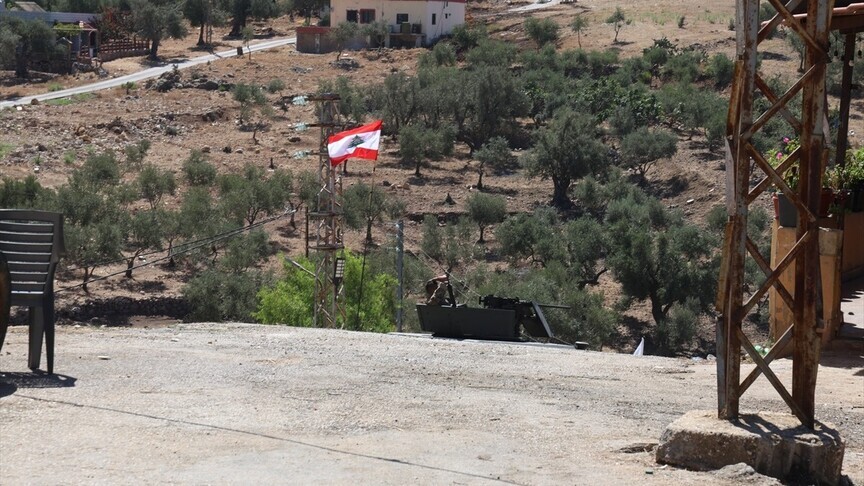
Land Clearing and Incursion into Lebanese Territory
The Anadolu Agency reported that Israeli bulldozers are working to clear a new road from the "Birkat al-Naqar" area towards the Shebaa Valley in southern Lebanon, while other areas witness military movements and clearing and demolition works. According to testimonies from citizens, clearing operations have advanced between one and one and a half kilometers into Lebanese territory, beyond the Blue Line drawn by the United Nations in 2000 to verify the Israeli withdrawal.
Shebaa town mayor, Muhammad Qasim Nabaa, pointed out that the road is located on lands owned by Shebaa residents, descending between Sedaneh Mountain and Hawaratha Valley, reaching apple, pomegranate, and plum orchards. He warned that the route is approaching residential areas at a distance of 100 to 200 meters, raising fears of Israeli forces reaching the heart of the town or damaging the water line that supplies the Arqoub area and Hasbaya District.
Population Decline and Economic Losses
Nabaa explained that the number of residents in Shebaa has dropped from about 11,000 in winter to approximately 5,000 people currently, due to security fears. For his part, Imad Atwi, a landowner in the Sedaneh area, said that military movements forced him to repeatedly move his livestock and sell a large part of his herd, which numbered about 300 goats, leaving him with only about 100 head now.
Atwi added that Israeli forces established military positions in the area, restricting available grazing spaces, noting that the loss affected his livelihood and ability to continue raising livestock. He called on the Lebanese state to find a solution for the area's residents, pointing out that UNIFIL patrols went to the valley to inspect the roads cleared by Israeli forces.
Damage to Infrastructure and Appeals to the State
For his part, Hussein Ali Zahra, a landowner whose property was damaged, said that the road reached the orchards and agricultural lands in Hawaratha Valley, causing damage to sewage networks and property. He clarified that residents tried to rebuild their livelihoods in areas such as Shnukh and Bastara about three years ago, but were unable to access those lands, and that livestock sheds in Birkat al-Naqar were destroyed.
Zahra affirmed that residents do not have easy options for relocation due to their livelihoods being tied to the land, calling on Lebanese President Joseph Aoun, Prime Minister Nawaf Salam, and Speaker of the Parliament Nabih Berri to pay attention to the situation of Shebaa residents. These movements come amid ongoing Israeli attacks that have killed at least 4,386 people and injured 12,407 others since March 2, in addition to displacing more than one million people.
Source: Anadolu Agency
Comments (0)