

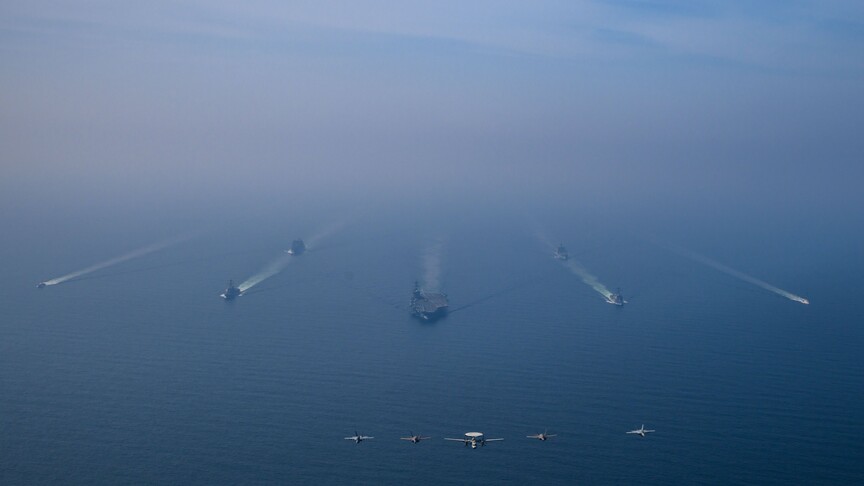
Israel's Institute for National Security Studies said on Tuesday that the current size of the US naval presence in the region exceeds what it was at the peak of Operation "Epic Fury" in February and March.
On February 28, the United States and Israel launched a war on Iran, and Iran responded with attacks on Israel and on what it says are US military facilities in Arab countries.
What the institute's statement said
The institute (a private body) said in a statement that it had compiled open-source data on the current number of US forces and naval vessels in the Gulf, the Arabian Sea, the Red Sea and the Mediterranean Sea.
It concluded that the current US naval presence "exceeds the size of the forces deployed during Operation Epic Fury, providing greater offensive capabilities and broader missile interception capacity." The institute did not specify the number of forces and naval vessels currently in the region.
According to an interactive map by the institute, the US aircraft carriers George Washington, George W. Bush and Theodore Roosevelt are present in the region, in addition to many warships.
Air power and the naval blockade
For some time, the United States has been imposing a naval blockade on Iran to push it to drop its conditions. Among Iran's conditions are a comprehensive ceasefire, the lifting of the naval blockade, and the release of frozen Iranian funds and assets.
On November 9, US President Donald Trump announced that the war with Iran had "effectively ended militarily", with what he described as "the largest naval and land blockade in history" continuing to pressure Tehran economically.
By contrast, despite the presence of more than 200 aerial refueling aircraft in the region, US air power based at land bases remains below March levels, according to the institute.
The institute added: "Aircraft have been repositioned westward within the Middle East or moved to Europe, reflecting how exposed forward bases are to the risk of Iranian attacks." It continued: "However, aircraft can be redeployed much more quickly than naval forces, meaning the air power balance in the region could change rapidly."
Negotiation track and nuclear dispute
Washington and Tehran signed a memorandum of understanding on June 18, but its implementation stalled amid disagreements over guaranteeing freedom and security of navigation in the Strait of Hormuz, which is strategic for energy and goods supplies. In July, confrontations between the two countries resumed, while diplomatic efforts to end the conflict continue amid its economic and political repercussions regionally and internationally.
Washington and Tel Aviv accuse Tehran of having two programs, one nuclear and the other missile, that threaten Israel and regional countries friendly to the United States, while Iran says its nuclear program is peaceful and that it does not seek to produce nuclear weapons or threaten other countries.
Israel, which occupies Palestine and territories in Lebanon and Syria, is the only country in the region that possesses a nuclear arsenal, which is not officially declared and is not subject to oversight by the International Atomic Energy Agency.
Source: Anadolu Agency
Comments (0)