

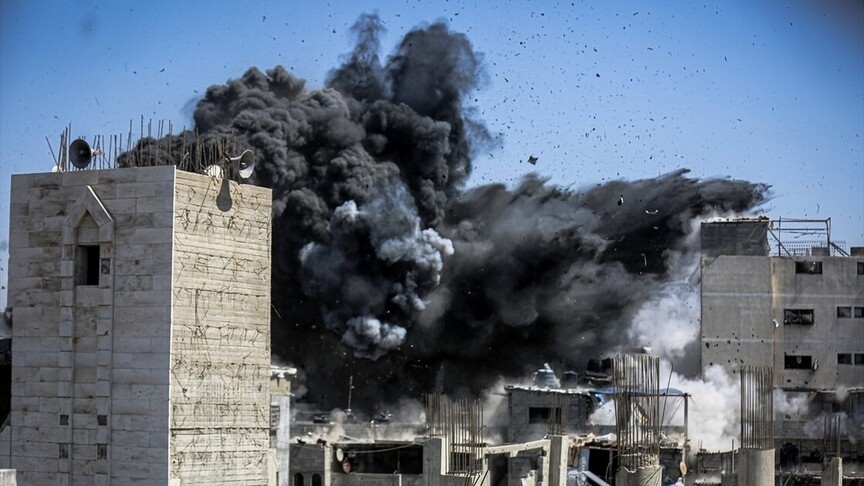
Gaza Municipality announced on Saturday that water has been cut off from large parts of the city due to damage to a main supply line caused by Israeli shelling, while Hamas warned against the reimposition of starvation policies against Palestinians in the Strip. This came in separate statements issued by the municipality and the Palestinian movement, amid worsening humanitarian suffering in the Strip due to the ongoing Israeli blockade since mid-2006 and the repercussions of the genocide war.
Destruction of Water Infrastructure
Gaza Municipality stated in a statement that an Israeli strike caused a break in a water line belonging to the Israeli company "Mekorot" in the Shuja'iyya neighborhood east of Gaza City, leading to water cuts in "large parts of the city." The Israeli water company "Mekorot" is one of the main sources supplying water to the Gaza Strip, which is under complete Israeli control, making this source, according to experts, a pressure tool on the population.
The municipality added that it is in contact with relevant authorities to coordinate and work on repairing the line and restoring water pumping as soon as possible. The stoppage of this line's supplies comes at a time when groundwater wells and water networks have been destroyed by Israel over three years of genocide. According to a previous statement to Anadolu Agency, environmental expert Saeed Al-Aklouk said that Israel has destroyed more than 80 percent of the water infrastructure in the Gaza Strip.
Famine Warnings
This coincides with a warning issued by Hamas against Israel's attempt to reimpose a starvation policy in the Gaza Strip. Hamas stated in a statement: "The occupation's move to reimpose a starvation policy against the people of the Gaza Strip reveals the manifest incompetence of the international community and the complicity of the Security Council and its institutions with this criminal Israeli policy." On Friday, the Euro-Mediterranean Human Rights Monitor warned of a renewed risk of famine in the Gaza Strip, due to shortages of flour and basic foodstuffs, bakeries ceasing operations, and the collapse of residents' purchasing power.
The Geneva-based Monitor stated in a statement that tightening the Israeli blockade and controlling the quantity, quality, and regularity of food entry, after destroying production sources and means of access, keeps more than two million Palestinians under the threat of deprivation of the essentials of survival, and reinforces the use of starvation as a tool in the ongoing genocide crime since October 2023. On Thursday, Nahid Shihab, head of the Gaza Private Transport Companies Association, said markets are suffering from shortages of basic food items, including potatoes, onions, cucumbers, tomatoes, and flour.
Continued Restrictions on Aid
He added in a statement that Israel controls the quality of goods allowed entry, while traders lack the freedom to determine the necessary goods needed by the population. Hamas explained that the Israeli occupation's impunity and lack of punishment for the previous starvation crime encouraged it to attempt repeating the same crime. The movement called on the official and popular Arab system not to allow Israel to repeat the starvation and blockade policy, urging it to take actual action regarding this.
Israel used starvation as a weapon during the genocide war it has been waging on the Gaza Strip since October/November 2023, according to government bodies and human rights organizations. In late 2023, hunger spread in the northern part of the Strip due to the blockade and Israeli restrictions on the entry of food and relief aid, forcing some residents to consume animal feed and herbs to stave off hunger. In May 2024, the Israeli military took control of the Palestinian side of the Rafah and Kerem Abu Salim crossings, hindering the entry of aid into the Strip.
After 81 days of strict closure of the crossings, Israel allowed, for the first time on May 22 of the same year, the entry of 87 aid trucks designated for international and civil institutions, according to the Gaza Government Media Office. Subsequently, aid continued to enter in a limited and sporadic manner under strict restrictions, until February 2026, when Israel, under a ceasefire agreement, allowed a limited increase in the number of trucks arriving at the Strip. Palestinian officials said the trucks do not contain sufficient quantities of basic food items. According to the Government Media Office, aid and goods trucks entering the Gaza Strip do not exceed 33.7 percent of the total agreed number.
Source: Anadolu Agency
Comments (0)