

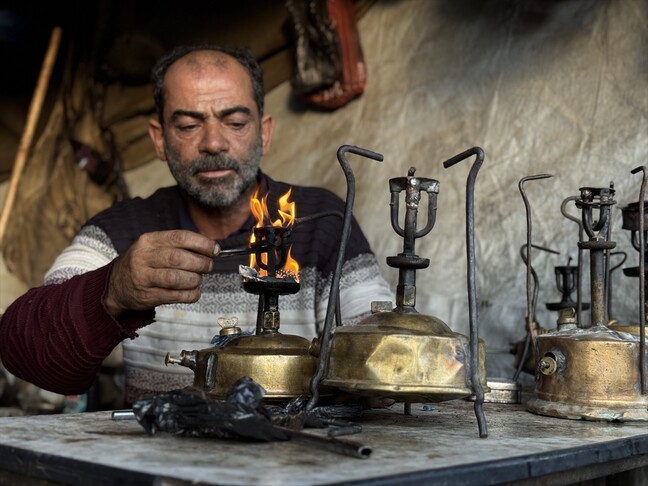
Kerosene stoves, known locally as "kaz burners," have returned to use in the Gaza Strip, after the cooking gas crisis and its soaring prices pushed Palestinians to look for alternative ways to prepare food and heat water. These stoves had become old keepsakes that some Palestinian families held on to as mementos.
With gas shortages continuing and fuel and firewood prices rising, Palestinians have found in the old stoves, which run on industrial diesel, a better and faster way to cook and heat water, as diesel prices are lower than those of cooking gas.
Roots of the Crisis
The signs of the cooking gas shortage in the Strip began when Israel started its genocidal war in October 2023, when it completely closed the crossings and barred the entry of goods, including gas. At that time, Palestinians first resorted to lighting fires with firewood, and when it ran out and its prices rose, they were forced to burn pieces of cardboard and plastic and to use worn-out clothes and shoes.
The crisis saw a limited easing with the ceasefire agreement taking effect on 10 October 2025, when Israel allowed between 5 and 9 trucks loaded with gas to enter daily, except on Fridays and Saturdays, according to Anadolu's monitoring of data from the Petroleum Authority in Gaza. According to figures from the Gaza Government Media Office, these quantities are below the minimum the Strip needs daily and below the quantities stipulated in the agreement's humanitarian protocol.
Israel soon reduced these quantities to only 4 or 5 trucks per day, and the days of entry to roughly two per week, last March, according to Anadolu's monitoring, amid Israeli accusations that Hamas seizes goods and raises their prices, which the movement has repeatedly denied.
High Prices and a Black Market
The price of a liter of industrial diesel reaches 20 shekels (about $6.7), compared with between 70 and 120 shekels (about $23.3 to $40) per kilogram of cooking gas on the black market, according to an Anadolu correspondent. Although the price of a kilogram of gas through the Petroleum Authority in Gaza is 9.3 shekels (about $3.1), the limited quantities and long waiting periods, which can reach 3 months to obtain a cylinder containing 6 to 8 kilograms, push residents to buy from the black market, which reinforces their turn to industrial diesel to run the old stoves.
Before the war began, a 12-kilogram gas cylinder cost about 70 shekels. According to the Anadolu correspondent, kerosene stoves now cost 1,200 shekels (about $400), amid rising maintenance prices due to a shortage of spare parts.
Some Palestinians in Gaza also turn to producing alternative industrial fuel from plastic, nylon and fabric waste that they collect from the rubble, by burning it in furnaces they have set up in areas far from residential concentrations. These people have made this activity their trade and it has become a source of livelihood, and the resulting fuel is used to run some diesel vehicles and old kerosene stoves, according to the Anadolu correspondent.
Testimonies from Residents
Palestinian Hassan al-Shabrawi was forced to flee many times before settling in the southern city of Khan Younis and opening a small workshop to repair old stoves. He told Anadolu: "We were displaced many times from Beit Hanoun (in the north), and we have now been in Khan Younis for more than two years." He added: "The severe Israeli blockade on Gaza pushed us to open a small shop to repair the burners (stoves), so we could provide them to people."
Al-Shabrawi noted that spare parts that previously cost a small sum now cost many times more, although a complete burner previously did not cost even 50 shekels. He added that people have started making the leather piece placed at the bottom of the burner from shoe leather, referring to a leather part used in the manual air pump to generate the pressure needed to run the stove, since original spare parts have become scarce.
For his part, Shawqi Abu Mughni, a 61-year-old displaced man in Khan Younis, told Anadolu: "I came looking for a burner to use as an alternative to gas, as gas prices are high, and every so often we manage to refill the cylinder with eight kilograms, and this amount is not enough." He added: "After the war, we went back to using things we did not use before, and we returned to the era of the burner, even to what came before the burner."
Palestinian Khaled Hassan told Anadolu: "Economic conditions and the high prices of gas and fuel pushed me to buy a kaz burner." He added: "Burners used to be merely keepsakes and decoration, but today we use them in our daily lives."
War Toll
Since October 2023, Israel, with US support, has been committing genocide in Gaza, leaving more than 74,000 Palestinians dead and more than 175,000 injured, most of them children and women. Israel has destroyed 90 percent of Gaza's infrastructure, with a reconstruction cost estimated by the United Nations at $71.4 billion.
Israel also prevents the entry into Gaza of the agreed quantities of food, medicine, medical supplies, shelter materials and prefabricated homes, where about 2.4 million Palestinians live, including 2.15 million displaced people, in catastrophic conditions.
Source: Anadolu Agency
Comments (0)