

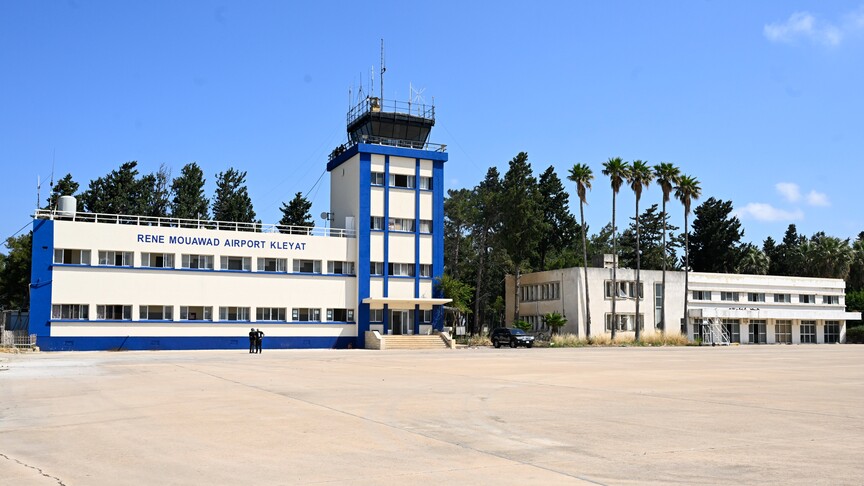
Flights Launch in November
The President Ren茅 Moawad Airport, known as "Qlayeat" Airport in northern Lebanon, is preparing to resume civil operations starting November 15, 2026. The restart project, officially launched on June 6, 2026, under the patronage of Lebanese Prime Minister Nawaf Salam, aims to relieve pressure on Beirut's Rafic Hariri International Airport and boost economic development in the Akkar region.
Engineer Elias Safir, a member of the tender file preparation committee at "Sky Lounge Services," the airport's operating company, confirmed that the company is committed to starting operations on schedule. He noted that the airport will begin with approximately two to three flights daily, with expectations of gradual increases as travel demand grows.
Expansion of Air Destinations
The first phase of operations targets regional destinations including Jeddah in Saudi Arabia, and Istanbul and Mersin in Turkey. The network is scheduled to expand in the second phase to include Doha, Dubai, and Riyadh, while the third phase will cover European and Arab destinations such as Paris, Berlin, and Cairo. Discussions are currently underway with Turkish airlines to prepare flight schedules.
The company expects the airport to serve approximately 100,000 passengers during its first year of operation. This number is projected to rise to between 600,000 and one million passengers over the next four years, with the full flight schedule and booking opening to be announced in early November.
Economic and Strategic Dimensions
The Qlayeat Airport, covering an area of approximately 5.5 million square meters, is a significant developmental project to strengthen economic ties with regional countries. Toufic Dboussi, head of the Chamber of Commerce, Industry, and Agriculture in Tripoli, emphasized that the airport's geographical location qualifies it to be a pivotal hub for air transport, especially given its proximity to the Syrian border and the Port of Tripoli.
Dboussi added that integration between the airport, the port, and the special economic zone could support trade and logistics flows. He also called for partnerships with advanced airports in countries such as Turkey, Singapore, and the UAE to develop the airport's capabilities, citing the development achieved by Istanbul Airport as a model to follow.
Source: Anadolu Agency
Comments (0)