

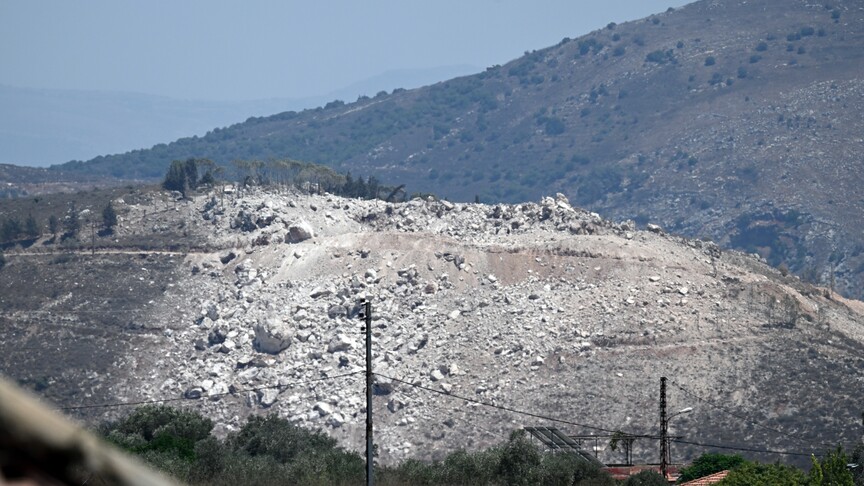
Lebanese residents in border areas of southern Lebanon face growing restrictions on access to their lands and pastures, due to continued Israeli shelling and military control over strategic heights. There are fears that Tel Aviv is trying to erase the region's geographic identity by imposing new names on it.
Restrictions on grazing and access to the heights
Residents and local officials, speaking to Anadolu Agency, complain that livestock herders have been shelled and detained, and that the space available for their agricultural and pastoral activities has shrunk after Israeli forces deployed on heights known locally as the "Wustani and Jawawir mountains." These heights lie on the western slopes of Mount Hermon, between the town of Shwaya and Mount Hermon, east of the Shebaa Farms and the Kfarshouba hills.
On 16 April, the Israeli army announced an airborne landing operation in the area, which gave it control of strategically important heights overlooking wide areas of Lebanese and Syrian territory, according to Israeli media.
Shebaa Mayor Adam Farhat tells Anadolu Agency that large areas of the heights are now outside the residents' usual movement, and that crossing some roads or climbing the mountains could expose them to sniper fire or shelling. He adds that some herders were shelled after going beyond the areas they are now allowed to reach, pointing to the targeting of two Syrian nationals along the mountain toward the town of Ain Ata in May. He explains that the shrinking grazing areas have harmed local economic activity, especially since livestock farming is a cornerstone of the economy of several neighboring towns.
Residents' account of the military presence
Hussein Barakat, former director of the teachers' department in Hasbaya, says the heights are a shared pasture for residents of Ain Ata, Khalwat, Shwaya, Ain Qinya and Shebaa. He notes that residents were not accustomed to permanent military sites on these heights, and that herders discovered the Israeli forces by chance when they went to a water pond used to irrigate land and water livestock.
Barakat recalls that Israeli forces detained some herders and asked them to tell residents not to cross a specific area, pointing to repeated incidents of herders being held for hours. He stresses that these measures have deprived residents of benefiting from grass and natural resources, and restricted their access to areas for recreation and hunting.
As for Salim Alwan Hudhaifa, from the town of Ain Qinya in the Hasbaya district, he says reaching the mountain peaks has become dangerous, and that shelling recurs at some sites without residents knowing its causes or aims. He reports that herders' movement is now limited to the lower areas, while the upper parts of the mountain have become a source of danger.
Lebanese objections to the Israeli name
Alongside the field restrictions, Israel's use of the name "Christofini Mountains" has drawn Lebanese objections. The International Humanitarian Law Committee of the National Human Rights Commission affirms that the name does not appear in official Lebanese maps or land registries. The committee considers that giving the area a new name is an attempt to impose a parallel geographic reality, and it warned of what it described as "cultural and geographic aggression," given the threat it poses to the historical identity of the land.
The committee warned that using unapproved names could create a geographic "grey zone" and make it harder for international observers to determine the positions of forces and the extent of their deployment. It cited the 1907 Hague Convention and the Fourth Geneva Convention in warning against infringing on the geographic and demographic character of territories under occupation. It also called for an official protest to be submitted to the UN Security Council, the UN Secretary-General and the Group of Experts on Geographical Names, to prevent the name from being entrenched in international maps and documents.
Background to the name and residents' position
Some people in the area link the name "Christofini" to a French officer killed during the French colonial period, and to a historic fort bearing his name in the town of Shwaya. Barakat explains that the officer was killed during the events of the Great Syrian Revolt in 1925, when clashes spread to areas of southern Lebanon. He adds that, according to the local account, the fort was built in memory of the officer and remained standing until it suffered major damage from an Israeli raid on 11 August 1969.
However, he stresses that residents did not know the name had been given to the heights. He says: "This is the first time we have heard that this mountain is called Christofini Mountain. We know it here in the region as the Wustani mountain, which separates our villages from the eastern range."
On the Israeli name, Hudhaifa says: "I am hearing this name for the first time. We know Ain Qinya mountain, Shwaya mountain and the Shebaa lands, and we know the Janaam and al-Jard areas. But we had never heard of this name before." Despite the shelling and restrictions, Hudhaifa affirms residents' attachment to their land and their refusal to leave, saying: "We are staying here and we will stay. This is our land, and it is our duty to protect it. We will not leave, no matter what happens."
Israeli attacks in southern Lebanon continue despite the signing of a "framework agreement" on 26 June, which provides for Israel's gradual withdrawal from occupied territories, in parallel with the deployment of the Lebanese army in these areas. A limited Israeli withdrawal from pilot zones began in July, without extending to other areas. Lebanese authorities accuse Israel of obstructing the implementation of the agreement by continuing raids, explosions and bulldozing, and by failing to complete its withdrawal from the lands it occupies.
Source: Anadolu Agency
Comments (0)