

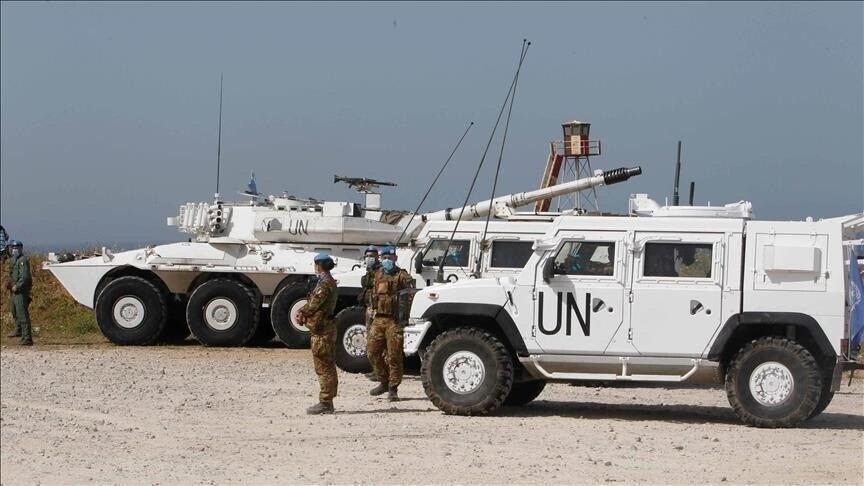
Security arrangements in southern Lebanon are entering a period of uncertainty as the mandate of the United Nations Interim Force in Lebanon (UNIFIL) nears its end at the close of this year. No agreed formula has yet emerged to continue monitoring the border between Lebanon and Israel, reporting violations, coordinating between the parties and supporting the Lebanese army.
Beirut insists on maintaining an international presence under the umbrella of the United Nations, while Washington calls for amending Resolution 1701 and seeking a new formula with a different composition and tasks. With Lebanese, American and Israeli positions diverging, analysts warned in remarks to Anadolu of a security and field vacuum if the mandate ends without agreement on an alternative.
Washington's and Beirut's Positions
During his visit to Beirut on Sunday, US Ambassador to the United Nations Mike Waltz said that amending Resolution 1701 has become unavoidable in order to seek a new international formula that differs in its composition and tasks. He added that Lebanon cannot be built on the existence of two armies, expressing hope that Hezbollah will hand over its weapons voluntarily. The group stresses that it is a "resistance movement" against the Israeli occupation present on Lebanese territory.
Waltz's statement came after meetings with Lebanese President Joseph Aoun, Speaker of Parliament Nabih Berri, and Prime Minister Nawaf Salam. The meetings addressed the options available after UNIFIL's mission ends, the role of the Lebanese army, the framework agreement between Lebanon and Israel under US sponsorship, and the issue of restricting weapons to the state. Lebanese army commander Rodolphe Haykal was absent from the meetings, and Waltz said that limited time led him to prioritize his meetings and focus on UN bodies and political leaders.
On 14 November, Aoun said that the priority is to renew UNIFIL's mandate, while remaining open to discussing an alternative mechanism under UN sponsorship if the mission cannot continue in its current form during 2027. He stressed that Resolution 1701 remains the legal reference for any future international arrangements in the south.
Two days later, during his meeting with Waltz, Salam stressed the need for the international presence to continue with a Security Council mandate, and for its tasks to include monitoring, reporting, coordination and liaison between the parties, and supporting the Lebanese army in extending state authority over all its territory. On the same day, Berri affirmed that the continuing Israeli occupation and attacks are the main obstacle to the Lebanese army's deployment up to the international border and to the return of displaced people to their villages.
Since 2 March, Israel has been waging an aggression on Lebanon that has left more than 4,300 dead, 12,400 wounded and more than one million displaced, according to Lebanese authorities.
Analysts' Assessments
Political analyst Ghassan Rifi told Anadolu that it is unclear who will fill the security and field vacuum that UNIFIL will leave behind. He added that a decision on the replacement force has become urgent, as forming it, organizing its work and deploying it to Lebanon requires a long time. He said the United States does not want an alternative international force in the south, which is consistent with Israel's position, and that Israel, he said, prefers that the Lebanese and Israeli armies alone remain in the area.
Rifi noted that the eighth round of the Tampa negotiations took on a military character and aimed to pressure Lebanon into accepting the formation of joint Lebanese-Israeli security and military committees to take over UNIFIL's tasks, but Beirut rejected the proposal. He considered that Washington seeks to put the Lebanese army before a fait accompli. He added that US Secretary of State Marco Rubio raised the possibility of using civilian entities to monitor the border, including the company Blackwater, which operated in Iraq, something Beirut and Hezbollah reject. He warned that the absence of an alternative could increase tension on the border, whether between the Lebanese and Israeli armies or between Hezbollah and Israel if escalation resumes.
For his part, political analyst Wael Najm said that UNIFIL's mandate ending on 31 December will be followed by withdrawal and evacuation operations beginning on 1 January 2027, which may continue until the end of that year, and that UNIFIL may continue performing some of its tasks during the withdrawal. He expected a security and field vacuum, especially given the Lebanese army's refusal to take on border protection under Israeli conditions or to become a border guard working in Israel's interest.
Najm added that Israel, for its part, stipulates specific arrangements and coordination mechanisms to approve any such formula, while the security arrangements agreed previously did not achieve the desired results. He pointed to attempts to explore the possibility of forming a multinational force in which European countries, including France, Italy and Spain, might take part, explaining that forming it requires coordination with Lebanon and Israel and a clear agreement on its tasks and powers, issues that still face obstacles. He linked the future of stability in southern Lebanon to regional developments, particularly the course of tension between the United States and Israel on one side and Iran on the other.
For her part, political analyst Maysaa Abdel Khalek said: "Renewing UNIFIL's mandate is Beirut's first option." She added that Beirut insists that any alternative UN or international force must operate under UN sponsorship, and that Salam's position during his meeting with Waltz sums up Beirut's direction. She warned of a dangerous security vacuum if UN forces are absent while Israeli violations continue and the occupation of Lebanese territory remains. She pointed out that Lebanese security forces, particularly the army, are not deployed in a number of occupied southern villages and towns, and that the army had to withdraw from some of its positions to avoid its personnel being attacked, despite casualties in its ranks.
Background to Resolution 1701
In 1978, the Security Council established UNIFIL under Resolutions 425 and 426, following the Israeli invasion of southern Lebanon. The force's tasks include verifying the withdrawal of Israeli forces, restoring international peace and security, and helping the Lebanese government extend its authority in the area. Its tasks expanded after the Israeli aggression on Lebanon in 2006, with the issuance of Resolution 1701, which set a framework for a cessation of hostilities, strengthening the Lebanese army's deployment in the south in parallel with the withdrawal of Israeli forces, and limiting the armed presence between the Blue Line and the Litani River to the Lebanese army and UNIFIL.
UNIFIL monitors the cessation of hostilities and the Blue Line, reports violations, coordinates between the Lebanese and Israeli armies, and helps the Lebanese army carry out its tasks.
On 28 August 2025, the Security Council adopted Resolution 2790, which extended UNIFIL's mandate for the last time until 31 December 2026. The resolution provided for an orderly and safe withdrawal within one year, in coordination with the Lebanese government and the force's contributing countries, and gradually reduces the force's field presence during 2027, while allowing it to perform specific tasks during the withdrawal.
Implementation of Resolution 1701 has not been completed, including the withdrawal of the Israeli army, the deployment of the Lebanese army and ensuring that weapons are restricted to the state. On 13 October, UN spokesperson Stéphane Dujarric said the organization had not been informed of any agreed plan for the continuation of the international presence in Lebanon, and that adopting any new formula requires a Security Council decision.
Source: Anadolu Agency
Comments (0)