

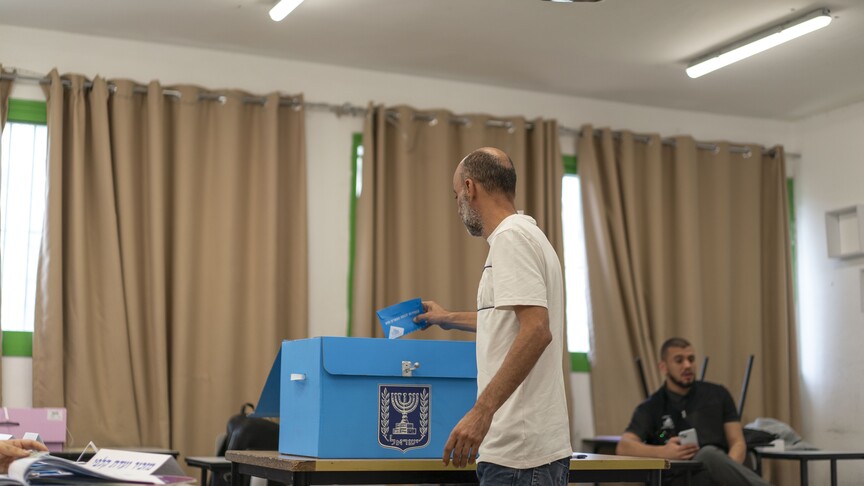
Updates of exit poll samples in Israel on Wednesday morning showed a tie between the camps of Prime Minister Benjamin Netanyahu and "Yesh Atid" leader Gadi Eisenkot, with 51 seats each, while Arab lists won 18 seats. This came in two separate updates from the samples of Israeli Channel "13" and the public broadcasting authority, after the samples published immediately after the closing of polling stations on Tuesday evening had shown an advance for Eisenkot's camp.
According to the update from the Israeli Broadcasting Authority, the Likud party led by Netanyahu topped the list with 27 seats, followed by "Yesh Atid" led by Eisenkot with 21 seats. The "Mahanim" list led by Naftali Bennett won 13 seats, while the Joint List won 11 seats, and the "Democrats" party led by Yair Golan won 9 seats. The "Israel Beiteinu" party also won 8 seats, and the Unified Arab List won 7 seats.
The parties Yehudut HaTorah, Jewish Power, Religious Zionism, and Shas were equal, each winning 6 seats. Thus, Netanyahu's camp, consisting of Likud, Shas, Yehudut HaTorah, Jewish Power, and Religious Zionism, won 51 seats. Eisenkot's camp also reached 51 seats, while the Arab lists (the Joint List and the Unified Arab List) won 18 seats.
In a separate update from the Channel "13" sample, the camps of Netanyahu and Eisenkot also won 51 seats each, compared to 18 seats for Arab parties. According to the channel's update, Likud topped the list with 27 seats, followed by "Yesh Atid" with 23 seats, then "Mahanim" with 13 seats, and the Joint List with 11. The "Democrats" won 9 seats, while "Israel Beiteinu" and the Unified Arab List each won 7 seats.
The Channel "13" sample also awarded Shas, Yehudut HaTorah, Jewish Power, and Religious Zionism 6 seats each. In contrast, the channel's sample showed that the "Am Yisrael" party led by Ofer Winther and the "Reserve and Economy" party led by Yoaz Hendel and Yaron Zliacha did not pass the threshold. The exit polls published immediately after the closing of polling stations on Tuesday evening had shown an advance for Eisenkot's camp over Netanyahu's camp, without either obtaining the majority needed to form the government, which is 61 seats out of 120.
The initial sample from the official broadcasting authority reported that Netanyahu's camp won 50 seats, compared to 53 for Eisenkot's camp and 17 for Arab parties. The initial sample from Channel "13" also gave Netanyahu's camp 50 seats, compared to 53 for Eisenkot's camp and 17 for Arab parties. The Channel "12" sample, meanwhile, showed Netanyahu's camp winning 50 seats, compared to 52 for Eisenkot's camp and 18 seats for Arab parties.
On Tuesday evening, the Israeli Election Committee announced in a statement that the voting turnout in the Knesset elections reached 77.7 percent, an increase of 7.1 percent over the 2022 elections, noting that it was the highest since 1999. Polling stations closed at 10:00 PM local time (20:00 UTC), after which vote counting began. The elections took place amid fierce competition between Netanyahu's camp and the opposition led by Eisenkot, while exit poll samples do not represent the official results of the elections.
Source: Anadolu Agency
Comments (0)