

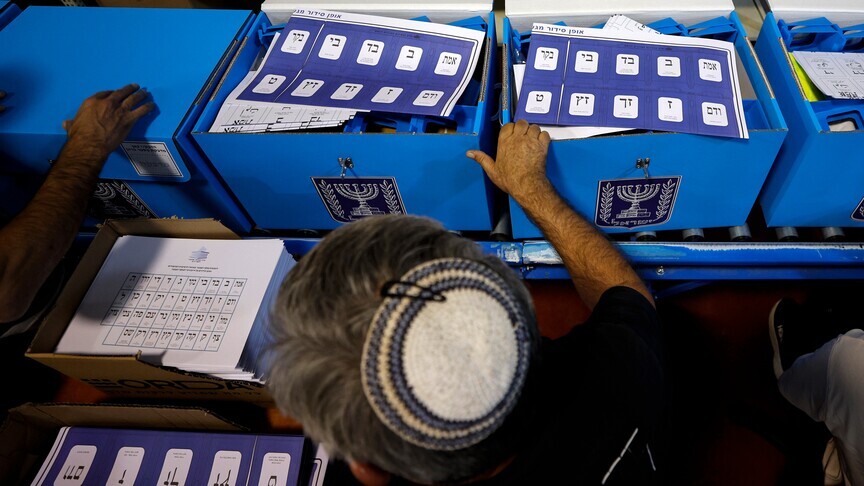
The results of counting 91 percent of Israeli voters' ballots showed that Prime Minister Benjamin Netanyahu's camp secured 53 seats, compared to 48 for the opposition Change bloc and 19 for Arab parties, leaving all parties without a majority to form a government.
Seat Distribution
Israeli Channel 12 stated that Netanyahu's bloc obtained 53 seats, compared to 48 for the Change bloc led by "Yesh Atid" party leader Gadi Eisenkot, while Arab parties won 19 seats. Thus, no bloc reached the majority required to form a government, which stands at 61 seats out of 120 in the Knesset (Parliament).
At the party level, "Likud" led by Netanyahu topped the results with 26 seats, maintaining its position as the largest party in Israel. The "Yesh Atid" party led by Eisenkot came second with 21 seats, while the "Meretz" party led by Naftali Bennett secured 12 seats, and the Joint Arab List won 11 seats.
The "Democrats" party led by Yair Golan won 8 seats, and the Unified Arab List led by Mansour Abbas won 8 seats. The "Yahadut HaTorah", "Israel Beiteinu", "Shas", and "Jewish Power" parties each obtained 7 seats, while the "Religious Zionism" party led by Bezalel Smotrich secured 6 seats.
Double Envelopes
The process of counting the remaining ballots continues, while the counting of "double envelopes" begins, which is expected to amount to between 430,000 and 480,000 votes, equivalent to approximately 8 to 9 parliamentary seats, according to the Hebrew newspaper "Israel Hayom". The voting mechanism via "double envelope" was designed to enable citizens who cannot cast their votes at their registered polling stations to vote.
This category includes, among others, Israeli Defense Forces soldiers, security force members, prisoners, and hospitalized patients, according to Hebrew media. On Wednesday morning, Eisenkot (a former chief of staff) pledged to form a "Zionist government," without clarifying how to achieve this without the participation of Arab parties, according to Channel 12.
According to partial results, Netanyahu's camp needs 8 additional seats to reach the majority required to form the government. Netanyahu and Eisenkot agree on rejecting the establishment of a Palestinian state, despite UN resolutions stipulating its establishment under the "two-state solution" principle.
On Tuesday evening, the Elections Committee announced that the voting turnout reached 77.7 percent, an increase of 7.1 percent over the 2022 elections, stating it was the highest since 1999.
Source: Anadolu Agency
Comments (0)