

Palestinian analysts linked the military operation carried out by the Israeli army in central Gaza to calculations over the formation of the Israeli government and the future of the arrangements under the ceasefire agreement announced on October 10, 2025.
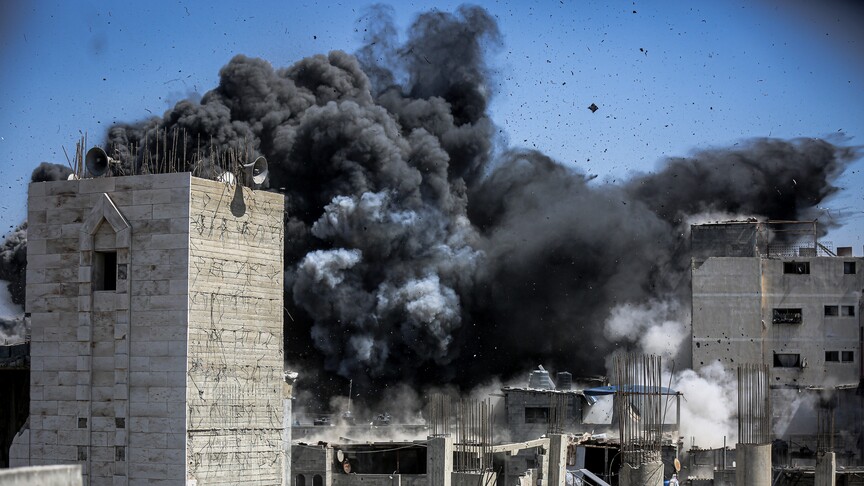
The Israeli army announced on Thursday the end of the operation it began on Wednesday in central Gaza and the reopening of Salah al-Din Street, a day after a ground incursion into areas west of what is known as the "Yellow Line," under the pretext of destroying a tunnel.
Details of the Operation
The army carried out the operation in areas from which it was supposed to have withdrawn under the ceasefire agreement, which it violates daily. This is the first ground operation by the Israeli army outside the "Yellow Line" since the agreement was announced.
The "Yellow Line" separates the areas occupied by the Israeli army from the rest of the Gaza Strip. The share of land occupied by Israel has risen from about 53 percent of the Strip's area when the agreement was announced to about 70 percent at present.
On Wednesday, Israeli vehicles pushed into the vicinity of the Bureij and Nuseirat camps and the Wadi Gaza bridge, amid shelling and gunfire and the closure of part of Salah al-Din Street, which left one Palestinian dead, others wounded and families displaced. At dawn on Thursday, the army carried out demolitions that hit Palestinian homes and facilities in central Gaza.
The area gains its importance from its proximity to the Wadi Gaza bridge on Salah al-Din Street, one of the two main roads linking the north of the Strip to the south, used by cars and by aid and goods trucks.
Since October 2023, Israel, with US support, has been committing genocide in Gaza, killing more than 74,000 Palestinians and wounding more than 175,000, most of them children and women, in addition to destroying 90 percent of the infrastructure. Despite the ceasefire agreement, Israel continues the genocide through daily bombardment that has killed 1,662 Palestinians and wounded 6,007 others, most of them children and women.
Abu Zubaida's Reading
Rami Abu Zubaida, a researcher in military and security affairs, saw the operation as an extension of Israeli policy since the ceasefire. He explained that the pace of large-scale shelling has declined, while incursions, targeted attacks and attempts to expand control have continued.
Abu Zubaida told Anadolu that the Israeli army is trying to reshape the security and geographic situation around its positions and expand its ability to intervene inside the Strip under the pretext of removing threats. On the significance of the site, he said Salah al-Din Street and Wadi Gaza are linked to movement and communication between the north and south of the Strip.
He considered it likely that the scope of incursions will widen as operations are repeated in other areas, becoming part of a gradual military policy that reshapes the geographic reality in the Strip. He warned that the operation could be a test of reactions, particularly in the absence of real pressure from the mediators.
He linked the timing of the operation to discussions on implementing the second phase of the agreement, which includes additional Israeli withdrawals and new security and administrative arrangements. Israel refuses to begin this phase, and first demands the dismantling of Hamas and the disarmament of Gaza.
Abu Zubaida considered it likely that caretaker Prime Minister Benjamin Netanyahu will try to leave complex security files to any incoming government, amid the Israeli political crisis and the tasking of Gadi Eisenkot with forming the government. Netanyahu is on trial on corruption charges that could lead to a prison sentence if he is convicted, and he has been wanted since 2024 to appear before the International Criminal Court over accusations of committing war crimes in the Gaza Strip since 2023.
Abu Zubaida said the military establishment helps determine Israeli policy toward Gaza, alongside the role of the prime minister, so a change of government does not guarantee a fundamental shift in Israel's goals. He warned that continued incursions could obstruct the deployment of the international stabilization force, weaken the role of the Palestinian committee for administering Gaza, and make the arrangements of the second phase subject to the facts the Israeli army imposes on the ground.
Positions of al-Qara and al-Madhoun
For his part, political analyst Iyad al-Qara, speaking to Anadolu, described the operation as "a dangerous development for Palestinians." He warned that this move "could be repeated in other areas under the same justification," referring to the claim of targeting a tunnel.
He explained that this could allow Israeli forces to advance between one and two kilometers west of the "Yellow Line," reaching deep into residential areas. He believed Israel seeks to keep the situation on the ground tense, reinforcing Palestinians' sense that the army can carry out military operations inside their areas despite the agreement being in force.
Al-Qara considered that Netanyahu may use escalation in Gaza to delay the formation of a new Israeli government, to pressure Israeli society and to send a message that the war continues. He also linked the operation to US efforts to restart the implementation of the agreement, considering that the escalation may be an Israeli response to those moves. He further believed that, through its operations west of the "Yellow Line," Israel is testing international reactions, as part of a policy aimed at expanding its control over land in the Strip.
Political analyst Ibrahim al-Madhoun also said the incursion came in the context of Israel's efforts to obstruct any move to implement the ceasefire agreement, benefiting from weak international pressure on it. He added to Anadolu that the silence of regional and international powers, the United Nations and the Board of Peace, and the absence of real pressure, encourage Israel to continue its attacks and violations.
Displacement and Destruction
The operation affected areas sheltering thousands of Palestinians who had already been displaced during the war, after Israel destroyed their homes or prevented them from returning to them.
The Government Media Office in Gaza said in a statement on Thursday that the Israeli army forced more than 6,000 Palestinians to flee again during its operation in central Gaza. It stressed that this crime "falls directly within the crime of systematic forced displacement against defenseless civilians."
The operation left widespread destruction affecting Palestinian property and infrastructure in central Gaza, while a limited number of displaced people returned to check on their homes west of the "Yellow Line," according to an Anadolu correspondent.
Source: Anadolu Agency
Comments (0)