

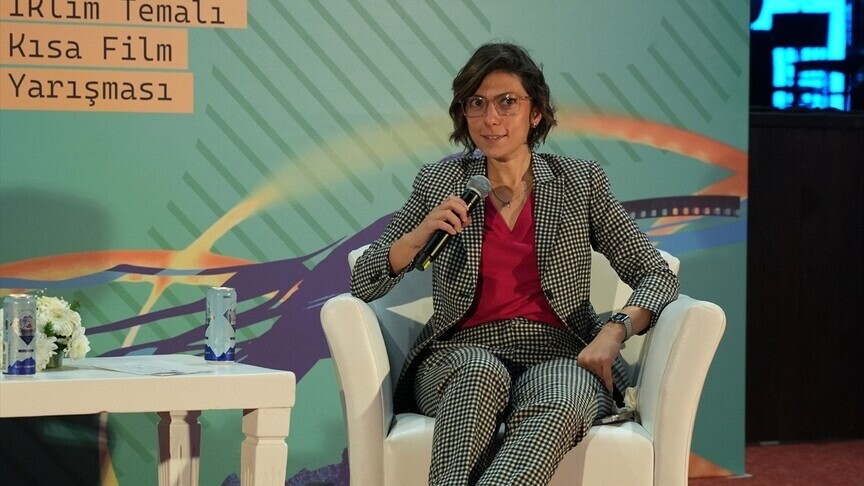
Palestinian director Darin Sallam, internationally known for the film "Farha", said that wars leave lasting effects on people, nature and cultural heritage, stressing that environmental destruction cannot be separated from human suffering.
She made the remarks during an event on Friday, the last day of the UN Climate Change Conference "COP31" in the Turkish province of Antalya.
Honored at the Climate Short Film Competition
The Climate Short Film Competition, held on November 14 under the slogan "The World Is Our Common Home", honored Sallam, a member of the competition's jury, by awarding her the "Spirit of Solidarity Award".
A total of 279 films from different countries were submitted to the competition, 10 of which reached the finals, while Sallam served on the jury alongside a number of Turkish filmmakers.
The Role of Cinema in Showing the Destruction
Sallam explained that she focuses on human stories in her work, and that the weapons used in wars cause long-term damage to water, soil, air, people and future generations.
She stressed the role of cinema in showing this destruction, saying: "We must tell these stories to resist what is happening in Palestine and the occupation, and to confront attempts at erasure."
She noted that the environmental effects of the Israeli occupation are not limited to Palestine and Gaza, but extend to southern Lebanon, where farmland, soil and residents have been harmed.
She added: "Environmental harm or destruction cannot be separated from people's suffering; they are all deeply interconnected," considering that Israel's targeting of the land is an attempt to erase Palestinian heritage, culture and identity.
Historical Roots and a Call for Sustainability
She affirmed that the destruction seen today in Palestine and Gaza did not begin recently, but has continued since 1948, explaining that the film "Farha" seeks to introduce audiences to the historical roots of this tragedy.
She cited Jaffa oranges, which were a symbol of Palestinian agricultural heritage, pointing to the seizure of land and the deprivation of Palestinians of its produce, as well as preventing them from gathering wild plants tied to their cuisine and culture, such as sage, thyme and molokhia.
She called on the film industry to adopt more environmentally sustainable productions, both behind the camera and in the content of the stories, stressing that the climate crisis is part of daily life and not a distant issue.
In the same context, COP31, which began on November 9, concluded on Friday, with the participation of government delegations and representatives of international organizations and civil society.
Source: Anadolu Agency
Comments (0)