

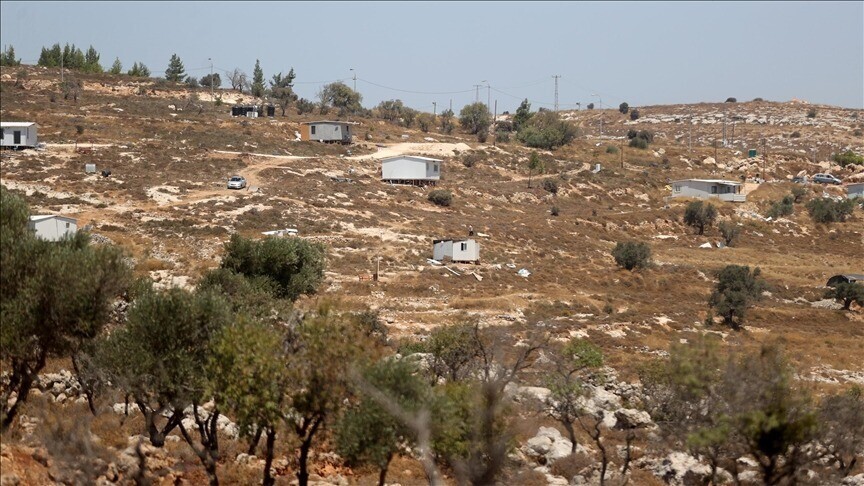
Jad Isaac, Director General of the Applied Research Institute – Jerusalem (ARIJ), warned of Israel's intensification of measures aimed at controlling Palestinian lands in the occupied West Bank, through military orders and land classification declarations as "state property," alongside the expansion of settlements and outposts and dominance over natural resources.
Isaac said in an interview with Anadolu that these measures aim to isolate Palestinian population centers from their agricultural lands and limit Palestinians' ability to access and exploit them, thereby consolidating Israeli control over additional areas of the West Bank.
Military measures and land classification
He clarified that Israeli military orders, including what he described as the "Red Line" in the Tubas area in the northern West Bank, are part of attempts to separate agricultural lands from Palestinian communities. The "Red Line" refers to an Israeli project in the northern Jordan Valley involving military orders to seize Palestinian lands and carve out a route that separates population centers from their agricultural and grazing lands, threatening to isolate approximately 118,000 dunams of Palestinian land.
Regarding the declarations classifying Palestinian lands as "state property," Isaac considered these measures "unacceptable under international law" and part of the current Israeli government's trends to expand its control over Palestinian lands. He pointed out that international legitimacy decisions, foremost among them UN Security Council Resolution 2334, affirm the illegality of settlement in the occupied Palestinian lands.
Settler attacks and resources
Isaac touched upon settler attacks in the West Bank, stating they include seizing lands, establishing outposts, and preventing Palestinians from accessing their fields. He added that violations do not stop at preventing farmers from accessing their lands but extend to stealing their crops, citing what happens during the olive harvest season.
Isaac warned of Israel's attempts to control Palestinian natural resources, especially water, emphasizing that international law does not permit an occupying power to control the resources of the lands it occupies. He criticized the role of the Israeli water company "Mekorot" in this context, stating that controlling Palestinian springs and water sources and linking them to land confiscation measures constitutes a violation of the rights of the population under occupation.
Enhancing agricultural resilience
In response to these measures, Isaac said that Palestinians have turned the repercussions of being prevented from working inside Israel, following the outbreak of the war on the Gaza Strip on October 7, 2023, into an opportunity to enhance their economic and agricultural resilience. He explained that farmers have turned to establishing protected greenhouses, noting that the number of protected greenhouses in the West Bank has increased by about seven times since the beginning of the war.
He added that this expansion has contributed to increasing vegetable production and providing part of the needs of Palestinian families, leading to achieving a degree of self-sufficiency in some food products at the household consumption level. He noted that the repercussions of this shift have begun to appear in West Bank markets, pointing out that some Israeli traders have started buying Palestinian crops and selling them inside Israel.
Local reactions
Isaac's statements come as Israeli measures to control areas of Palestinian land in the West Bank continue. The Palestinian Wall and Settlement Resistance Authority stated last Tuesday that Israeli authorities issued a declaration classifying 2,536.44 dunams of lands in the towns of Beitillu, Al-Mazra'a Al-Qabliya, and Deir Ammar, northwest of Ramallah, as "state property."
Palestinian institutions say that these measures, along with settler attacks and military restrictions on the movement of Palestinians and their access to their lands, contribute to expanding Israeli control over the land and limiting the potential for agricultural and urban expansion in Palestinian towns and villages.
Source: Anadolu Agency
Comments (0)