

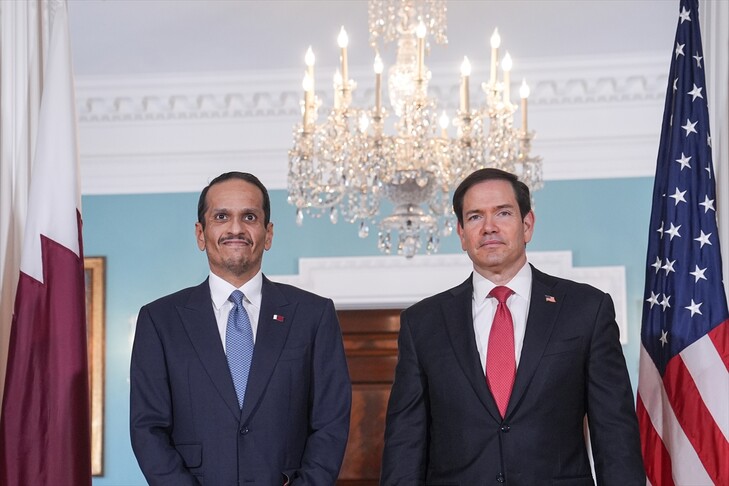
Qatar and the United States discussed strengthening their defense partnership, economic and technological cooperation, and diplomatic efforts to de-escalate tensions and enhance security and stability in the region, during the eighth Strategic Dialogue between the two countries in Washington.
This was stated in a Qatari Foreign Ministry statement on Tuesday regarding the dialogue, chaired by Prime Minister and Foreign Minister of Qatar Mohammed bin Abdulrahman and US Secretary of State Marco Rubio, amid continuing tensions between Washington and Tehran and Doha's mediation efforts between them.
The Eighth Strategic Dialogue
According to the statement, the two sides reviewed during the eighth round of the Strategic Dialogue ways to strengthen cooperation and partnership between the two countries in the political, economic, trade, investment and cultural fields.
The two sides also discussed the latest regional developments, particularly the diplomatic efforts underway and joint coordination to de-escalate tensions and enhance security and stability in the region.
Artificial Intelligence and Critical Minerals
The two sides also discussed cooperation in artificial intelligence, and the dialogue witnessed the signing of a partnership to accelerate artificial intelligence, along with a memorandum of understanding on addressing "critical minerals", as well as discussing the development of relations in the field of international cooperation.
According to the US classification, "critical minerals" refers to mineral materials of importance to the economy and national security, whose supply chains may be disrupted.
The US list includes minerals such as lithium, cobalt and nickel, as well as rare earth elements, which are used in manufacturing batteries, electric vehicles, electronics and defense technologies.
The eighth Strategic Dialogue also discussed "new opportunities for cooperation in Latin America, along with emphasizing the defense partnership and the importance of freedom of maritime navigation, in addition to discussing a number of issues of mutual interest."
Session on Regional and International Issues
On the sidelines of the Strategic Dialogue, the two countries held a session on regional and international affairs, chaired by Qatari Minister of State for Foreign Affairs Mohammed bin Abdulaziz, while the US side was headed by Assistant Secretary of State for Near Eastern Affairs Donald Blome, according to a second Qatari Foreign Ministry statement.
During the session, they reviewed the strategic cooperation relations between the two countries and ways to support them, as well as the diplomatic efforts underway to de-escalate tensions and enhance security and stability in the region. They also addressed a number of regional and international issues of mutual interest, including developments in the Gaza Strip, Syria, Lebanon, Iran and Afghanistan, in addition to the latest situations in Africa and Latin America.
The two sides also discussed efforts aimed at supporting peaceful settlement tracks for conflicts and strengthening stability.
The first Strategic Dialogue between Qatar and the United States had been held on January 30, 2018 in Washington.
Qatari Mediation Between Washington and Tehran
The talks come amid escalating military tensions between the United States and Iran, and efforts by Qatari and Pakistani mediators to end the war between them permanently. Recently, Qatari diplomacy has intensified its movements toward Tehran and Washington, seeking to prevent a renewed military escalation between the United States and Iran.
Qatar's recent moves included meetings with American and Iranian officials, while Tehran said it is ready to open the Strait of Hormuz if the US administration accepts its demands.
For its part, US President Donald Trump accused Tehran of not being serious about reaching an agreement, and threatened new military operations after the end of the current year.
On February 28 of this year, the United States and Israel began a war on Iran, and the latter responded with attacks on Israel and what it said were "American military facilities" in Arab countries.
Washington and Tehran signed a memorandum of understanding on June 18 of this year, but its implementation has stalled amid disputes over guaranteeing freedom of navigation in the strategic Strait of Hormuz.
Since July, confrontations between Washington and Tehran have recurred from time to time, amid continuing diplomatic efforts to end the conflict in light of its economic and political repercussions regionally and internationally.
Source: Anadolu Agency
Comments (0)