

Joint Statement After the Eighth Strategic Dialogue
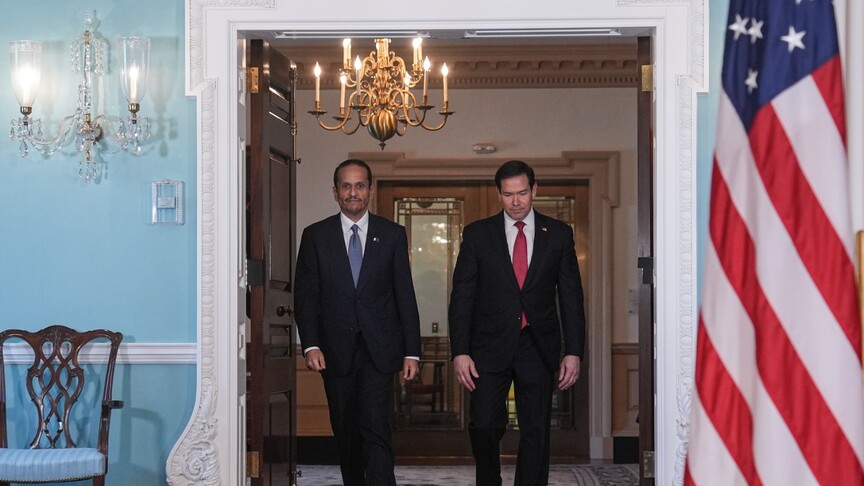
Qatar and the United States reaffirmed on Tuesday their commitment to preserving freedom of navigation in the Strait of Hormuz, stressing the importance of ensuring safe and unobstructed passage through the vital waterway for the security of the region and the stability of energy supplies and the global economy. This came in a joint statement issued after the conclusion of the eighth Strategic Dialogue between the two countries, held on Monday in Washington. It was chaired by Prime Minister and Foreign Minister of Qatar Mohammed bin Abdulrahman and US Secretary of State Marco Rubio, with senior officials from both sides participating.
According to the statement, "the two sides reaffirmed their commitment to preserving freedom of navigation through the Strait of Hormuz," confirming that "ensuring safe and unobstructed passage through this vital waterway is essential for the security of the region and the stability of energy supplies and the global economy."
The first Strategic Dialogue between Qatar and the United States was held in Washington on 30 January 2018.
Positions of the Two Sides and Defence Cooperation
In the same context, Rubio reaffirmed the United States' commitment to Qatar's security, stressing the importance of the defence partnership between the two countries in strengthening joint capabilities and protecting mutual interests. The two sides affirmed their commitment to deepening cooperation and advancing regional and international priorities through diplomatic action, and to expanding opportunities for economic, commercial and investment cooperation.
For his part, the Qatari Prime Minister praised the efforts of US President Donald Trump to reach agreements resolving regional disputes, stressing the central role of American diplomacy in creating the conditions needed to achieve lasting peace. Rubio, on behalf of Trump, expressed appreciation for Emir of Qatar Tamim bin Hamad and the Qatari government for their leading role in international mediation, and as a close partner in efforts to promote peace, stability and security. Rubio affirmed that the partnership between the two countries represents "a model of peace through strength, and a force supporting stability amid regional and global challenges."
Issues Discussed
The two sides discussed a number of issues of shared interest, most notably the situation in the Gaza Strip, Iran, Syria, Lebanon and Afghanistan. The talks also covered the situation in the Democratic Republic of the Congo, the Sahel region, Rwanda, Somalia, Bolivia and Haiti.
Rubio expressed appreciation for Qatar's continued support for Haiti, including Doha's pledge of $30 million to the United Nations trust fund for the Gang Suppression Force. The eighth Strategic Dialogue comes as Qatar and the United States prepare to celebrate the 55th anniversary of the establishment of diplomatic relations between them, according to the statement.
According to the statement, talks are scheduled to continue in early 2027 on defence, security cooperation, counterterrorism and law enforcement, as well as cultural ties.
Regional Context
Recently, Qatari diplomacy has intensified its efforts toward Tehran and Washington, seeking to prevent a renewed military escalation between the United States and Iran, amid skirmishes that included US strikes on targets on Iranian islands and Iranian attacks on sites in some countries of the region. Recent Qatari efforts have included meetings with American and Iranian officials, while Tehran has said it is ready to reopen the Strait of Hormuz if the US administration accepts its demands.
In contrast, Trump accused Tehran of being "not serious about reaching an agreement," and threatened new military operations after the end of the current year. On 28 February, the United States and Israel launched a war on Iran, and the latter responded with attacks on Israel and on what it described as "US military facilities" in Arab countries.
Washington and Tehran signed a memorandum of understanding on 18 June, but its implementation has stalled amid disagreements over guaranteeing freedom of navigation in the strategic Strait of Hormuz. Since July, confrontations between Washington and Tehran have periodically resumed, amid continued diplomatic efforts to end the conflict, in light of its economic and political repercussions regionally and internationally.
Source: Anadolu Agency
Comments (0)