

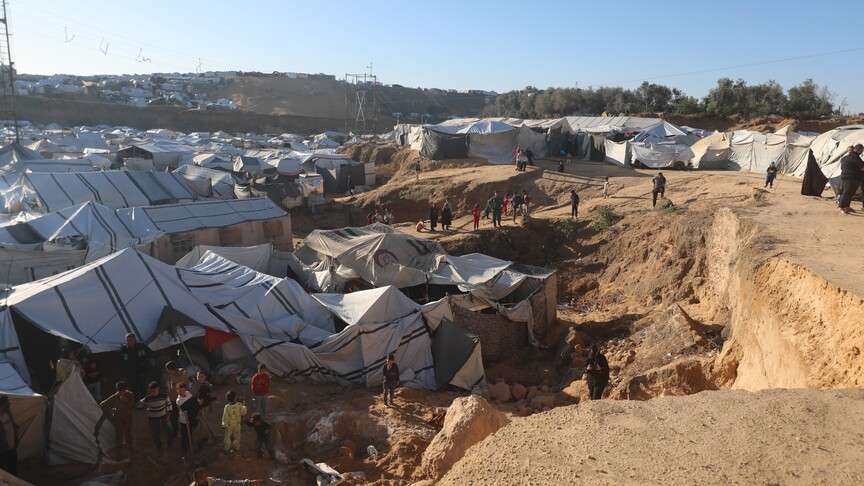
A sand and rock collapse claimed the lives of 5 people, including two women and three children, in the city of Deir al-Balah in central Gaza Strip on Sunday evening, after burying tents housing displaced families. Palestinians and civil defense teams, using simple tools, attempted to dig to extract those trapped under the sand amid a shortage of equipment and machinery necessary for rescue operations.
The tragedy occurred due to the impact of a weather system that has been striking the Strip since Friday evening, accompanied by heavy rains and strong winds. Civil Defense spokesperson Mahmoud Bassal confirmed that the collapse affected tents housing displaced families, emphasizing that protecting the lives of displaced persons is an urgent humanitarian responsibility and their tents must not turn into death traps.
The Supreme Committee for Winter Emergencies in Gaza announced that the weather system caused more than 70,000 tents to flood and affected approximately 350,000 people, due to rainfall ranging between 45 and 55 millimeters over 6 hours. It noted that the affected individuals belong to more than 1.5 million displaced persons residing in approximately 2,100 camps comprising nearly 270,000 tents.
Civil Defense warned of increasing risks of sand and rock collapses, especially in sites near slopes and unstable soil. It also called on international institutions to provide safe shelter and renewed its appeal for providing necessary equipment for its teams, given the limited available resources.
The Committee clarified that Social Development teams recorded severe damage to 174 camps and direct damage to 6,201 families across the Strip's five governorates. It added that tents and relief supplies have begun to be distributed to 1,000 affected families, in coordination with humanitarian agencies.
As an indicator of the limited response, Civil Defense announced receiving 2,166 distress calls since the onset of the weather system, with its teams managing to respond to only 218 of them. The Winter Emergencies Committee also warned of 4,500 buildings classified as dangerous and prone to collapse, including 90 buildings requiring immediate demolition.
Hundreds of thousands of Palestinian families are living in tents and temporary shelter centers after the Israeli army destroyed their homes during the war that began on October 8, 2023. Despite the ceasefire agreement being in effect since October 10, 2025, the shelter crisis continues to worsen, with Israeli restrictions on importing construction materials and relief supplies persisting.
Warnings of collapses
Impact of the weather system
Shortage of equipment and resources
Continuation of the shelter crisis
Source: Anadolu Agency
Comments (0)