

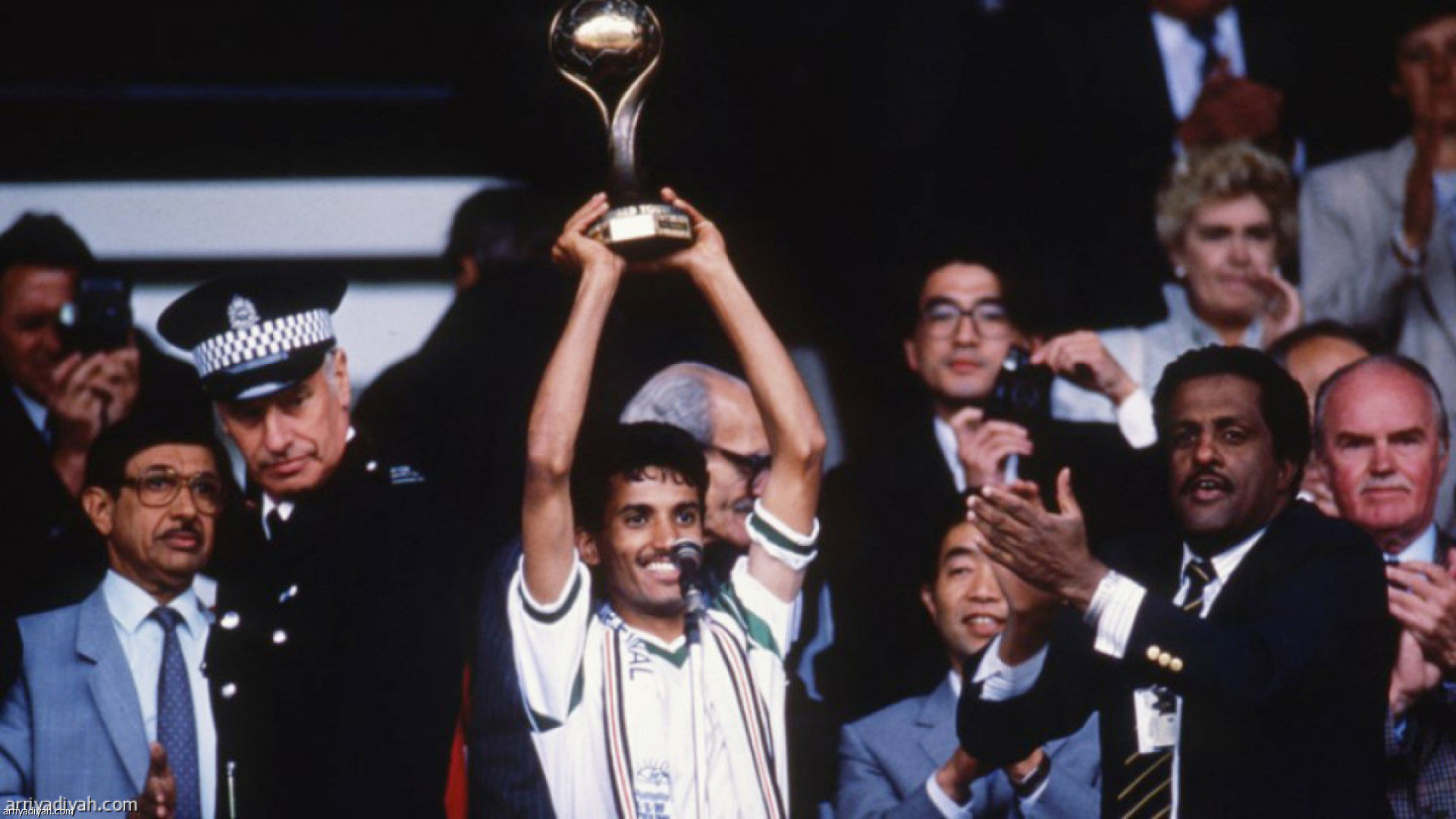
The Saudi under-16 national football team were crowned world champions in 1989 in Scotland, after beating the Scottish team 5-4 on penalties in the final. Al-Akhdar had taken part in the 1985 edition and reached the quarter-finals, then took part in 1987 and went out in the first round.
Al-Akhdar's Path in the Tournament
Al-Akhdar qualified from Asia alongside China and Bahrain, and the draw placed them in a group that included Portugal, Guinea and Colombia. They opened with a 2-2 draw against Portugal, the title favorites, with Jubarti al-Shamrani scoring both goals, in the 60th and 80th minutes, after Lu铆s Figo had opened the scoring for his country.
The 2-2 draw was repeated in the second match against Guinea, where Guinea defender Mory Fofana put the first Saudi goal into his own net by mistake, before the late Khaled al-Ruwaihi added the second, equalizing goal. In the third match against Colombia, al-Ruwaihi snatched the winning goal in the final minute to take his teammates to the quarter-finals.
In the quarter-finals, the Saudis faced Nigeria, holders of the title from two editions earlier, and the match went to penalties, in which goalkeeper Mohammed al-Deayea shone by denying the Nigerians any goal, as Al-Akhdar won 2-0. At the same time, Lu铆s Figo was leading Portugal to the semi-finals at the expense of Argentina.
In the semi-finals, the team faced Bahrain, who had eliminated Brazil, and al-Ruwaihi scored the only winning goal in the 47th minute, while Brian O'Neil led the host country to eliminate Portugal.
The Final Against Scotland
In the final, the Saudi team faced the Scottish side, playing on home soil in front of their own fans. In a tactically exhausting match, the hosts took an early lead after seven minutes with a shot from Ian Downie, and Paul Dickov strengthened the lead with a second goal in the middle of the half.
At the start of the second half, Sulaiman al-Rashoudi reduced the deficit with a powerful shot in the 49th minute, before Walid al-Turair equalized a quarter of an hour before the end of the match, sending the tie to penalties. Mohammed al-Deayea shone again and saved a decisive kick, while the Scots missed another.
Saud al-Hamali, Mansour al-Mousa, Jubarti al-Shamrani, Walid al-Turair and finally Salem Sarour scored for the team, while Abdullah al-Thunayan missed the fourth kick, and Al-Akhdar were crowned world champions.
What Became of the Champions
The list of champions included names that later became prominent stars in the history of Saudi football, while some of them left the pitch early because of injuries.
Mohammed al-Deayea was a player at Al-Taee before moving to Al-Hilal, and he continued playing until 2010, winning 18 titles with Al-Hilal and 6 titles with the Saudi national team, and took part with it in the World Cup four times. Sulaiman al-Rashoudi, a player at Al-Taawoun, moved to Al-Hilal in 1993 and played seven seasons with them before injury forced him to retire.
Adnan Abdulshakoor, a player at Al-Wehda, moved to Al-Nassr in 1995, then returned to Al-Wehda five years later and retired a few months afterward. Aref Borshaid, a player at Al-Qadsiah and one of the members of the club's golden generation that won the Asian Cup Winners' Cup, retired at the start of the millennium because of injury. Abdullah al-Hamdi, a Hajer defender, led his team to promotion to the Premier League, before retiring at the start of the millennium and stepping away from football.
Khaled al-Ruwaihi began his career at Al-Watani in Tabuk and was crowned the tournament's top scorer with 3 goals, then moved to Al-Ahli, but he died in 1992 in a traffic accident. Saud al-Hamali, the team captain and an Al-Nassr player, contributed to Al-Nassr winning the King's Cup in 1989 and the league in 1994, then played briefly for Al-Riyadh and retired five years after lifting the World Cup.
Jubarti al-Shamrani played for Al-Ittihad for more than 13 years and contributed to 9 titles, before retiring after helping win the league in 1999. Walid al-Turair, an Al-Nassr striker, retired in 1993 because of injury. Salem Sarour, who took the golden penalty, contributed to 15 titles for Al-Shabab and took part with the national team in winning the 1994 Gulf Cup.
Abdullah al-Thunayan, an Al-Nassr defender, stayed with the club until his retirement in 1993, having reached the first team in 1989. Mansour al-Mousa, a player at Al-Najma, moved to Al-Nassr in 2000 for a short period, then returned to Al-Najma and retired to move into administrative work, after contributing to his team's promotion to the Premier League in 1997.
Salman al-Qarni, an Al-Nassr player, retired in 1992 and moved into administrative work, working with the youth national teams, then took charge of football affairs at Al-Nassr and later supervised the senior national team, and also worked at the Saudi Football Federation. Fuad Anwar led Al-Shabab to 10 titles, contributed 3 titles with the national team and two World Cup qualifications, moved to Al-Nassr in 1999 and retired two years later because of injury, then turned to coaching and sports analysis.
Mohammed al-Tamyat, an Al-Hilal striker, retired early in 1994 because of injuries. Shaker al-Olayan, "the Brave", an Al-Nassr goalkeeper, retired in 1998 after contributing to five titles for Al-Nassr, and died in 2018 at the age of 46.
Source: Arriyadiyah newspaper
Comments (0)