

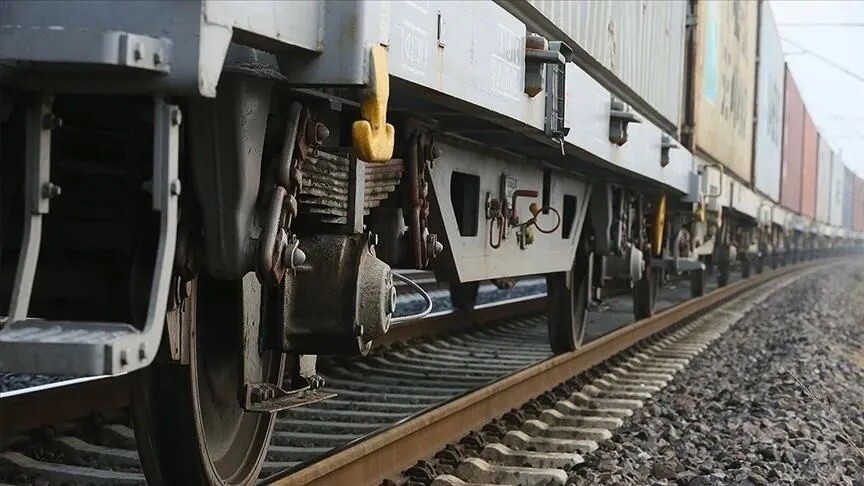
The six Gulf Cooperation Council states are continuing work to complete the railway network linking them, about 17 years after it was approved, and progress has passed 55 percent. The network stretches 1,768 kilometers, and the project aims to begin operations by December 2030.
The network provides additional routes for transporting goods to ports and markets, and the need to complete it is greater than ever, especially after the disruption to navigation in the Strait of Hormuz and its economic repercussions for the Gulf states. Two experts who spoke to Anadolu said the network will support intra-regional trade and ease pressure on maritime transport, while its implementation faces challenges related to financing and unifying operating standards, in addition to risks arising from regional tensions.
Signing of the Agreement and Al-Budaiwi's Statements
The Gulf Cooperation Council announced on 8 November that the general agreement for the project had been signed in Manama, in the presence of the transport and communications ministers of Saudi Arabia, the UAE, Qatar, Bahrain, Oman and Kuwait.
The Council's Secretary-General Jasem Al-Budaiwi said the project "plays a role in facilitating the movement of passengers and goods, and linking land transport networks to ports and logistics hubs." He noted that integrating Gulf capabilities and diversifying supply routes strengthen the member states' ability to face crises and maintain the stability of their markets.
In a briefing to the UN Security Council on 14 November, Al-Budaiwi said the member states had been subjected since 28 February to Iranian attacks involving more than 7,000 missiles and drones. He said the attacks targeted airports, ports, and energy, electricity and desalination facilities, as well as residential areas and civilian facilities. He added that they caused deaths and injuries, inflicted severe damage on infrastructure, and had serious repercussions for the marine environment in the Arabian Gulf.
Hormuz and Economic Losses
On 28 February, the United States and Israel launched a war on Iran, and Tehran responded by attacking Israel and what it said were American military sites in Arab countries. With navigation in Hormuz disrupted, the Gulf states turned to alternative routes, most notably Saudi Arabia's East-West pipeline and the UAE's Habshan-Fujairah pipeline, in addition to Omani outlets.
The strait lies between Iran to the north and the UAE and Oman to the south, and connects the Arabian Gulf with the Gulf of Oman and the Arabian Sea. About 40 percent of seaborne oil, 20 percent of liquefied gas, and 22 percent of essential commodities worldwide pass through it.
On 11 November, the firm Allianz Trade estimated the material damage caused by the war in the Arab Gulf states at more than 200 billion dollars, and projected cumulative economic losses of 790 billion dollars by 2030. The Gulf states have neither confirmed nor denied these estimates.
The Two Experts' Views
Kuwaiti economist Nader Al-Obaid told Anadolu that the project is "one of the most important Gulf strategic projects." He said it "achieves operational and logistical integration among the six states, eases pressure on maritime transport lines, and facilitates intra-regional trade and the exchange of expertise."
He added that the network "may revive service, industrial and tourism areas that have not received attention, open investment opportunities for the private sector in ports, trade and tourism, and attract global companies that contribute to the transfer of knowledge and technology and the development of local skills." He said Kuwait "can link its development projects to the network and prepare to open up to the Iraqi and Iranian markets when the region stabilizes, thereby strengthening its economic and food security and diversifying its sources of income."
Al-Obaid pointed to "financing challenges tied to the economic conditions of the region's countries, unifying technical standards and ensuring operating efficiency given differing methods of facility management, as well as facilitating customs procedures amid varying security requirements at the borders."
For his part, international economy and energy expert Nihad Ismail said the project is "a strategic step, and that accelerating and completing its implementation are tied to resolving the conflict between Iran on one side and the United States and Israel on the other." He said implementation is also tied "to how receptive Tehran is to projects that ease tension with its neighbors."
He explained that Iran "may see routes that reduce dependence on Hormuz as a challenge to its ambitions or an attempt to marginalize its regional role." He called for "consulting with Tehran and exploring ways to involve it in major strategic projects to avoid security obstacles or attempts to disrupt transport and supply lines." He stressed "the project's importance for development," urging "cautious handling of the risks arising from regional instability, and working to reach understandings with Tehran."
Project Phases and Completion Rates
According to the Gulf Railway Authority and the GCC, the Supreme Council approved the establishment of the network on 14 December 2009, and decided to create the authority to implement it on the same day in 2021, then two years later set December 2030 as the target date for operations.
Overall completion stands at 55.92 percent, while route reservation stands at 94.45 percent, land acquisition at 66.06 percent, and engineering designs at 73.46 percent. Civil works have reached 43.22 percent, track works 39.61 percent, and signaling and communications 43.06 percent.
The route extends 1,768 kilometers from Kuwait to Dammam in eastern Saudi Arabia, which is linked to Bahrain via a planned bridge. The line runs from Dammam to Qatar and then the UAE, reaching Muscat via Sohar, while the initial cost of the core infrastructure is estimated at between 15.4 and 16 billion dollars.
Saudi Arabia holds 672 kilometers of the network, followed by the UAE with 461 kilometers, then Oman with 330 kilometers, Qatar with 141 kilometers, Kuwait with 111 kilometers, and Bahrain with 53 kilometers.
Passenger trains reach speeds of 200 kilometers per hour, while freight train speeds range between 80 and 120 kilometers per hour, and the network uses the European signaling system. According to Gulf media, the project aims to carry about 6 million passengers and 200 million tons of goods in 2030, with the number rising to more than 8 million passengers and freight volume to 271 million tons by 2045.
Source: Anadolu Agency
Comments (0)