

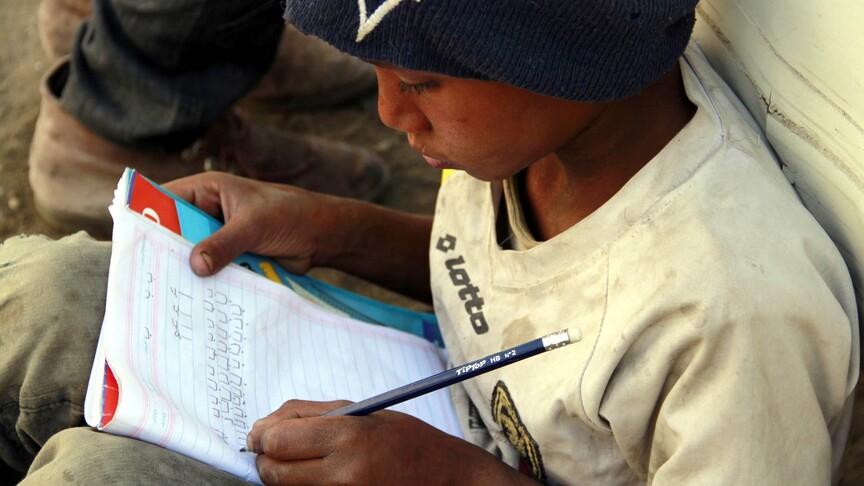
Students in Taiz, in southwestern Yemen, are following their lessons via the WhatsApp application after schooling in the city's schools was disrupted for about a month as the siege imposed by the Houthi group tightened.
The United Nations Children's Fund (UNICEF) announced on Wednesday that more than 1,160 schools have closed their doors or suspended classes in the areas affected by the escalation in Taiz, affecting more than half a million students.
The siege and the humanitarian situation
The Houthis have tightened their siege on the city since early October, after seizing the vital western entrance linking Taiz governorate to the governorates of Lahj and Aden, leaving all of the city's entry points under their control.
The organization said that the closure of the main road from Aden to Taiz and the lack of security on alternative routes had, according to reports, cut off more than 800,000 people from humanitarian aid until late October, while water production dropped by about 50 percent.
It added that food and fuel prices have more than doubled, while shortages of medicine, fuel, medical oxygen and electricity are threatening emergency care and maternal and newborn care services.
Testimonies from teachers and parents
Teacher Maryam al-Hamdani told Anadolu that following lessons becomes harder when five or six siblings in the same household need to use the same phone at the same time. A teacher of the early grades at the public "Zayd al-Mushki" school, she added that the authorities ordered public and private schools closed for fear that students would be exposed to Houthi shelling, and that the decision was difficult for students, their families and teachers.
She explained that teachers "sought to register students on electronic platforms and create learning groups according to school grade, while many parents find it difficult to follow the lessons, and a number of teachers have difficulty using these tools." She noted that "weak internet and its frequent outages hinder lessons, and that some families own only a basic phone, while many have no computers," stressing "the readiness of teachers to teach from their homes or to go to students' homes and to closed, safe places to teach them."
For his part, teacher Mohammed al-Asbahi told Anadolu that "receiving lessons by phone is harder than attending them in class, and that families' deteriorating conditions and the difficulty of going out to work because of the siege prevent them from providing phones for their children, especially when a family has several students." He added that "the closure of schools has increased the psychological and living burdens on students, their families and teachers, while financial obligations remain, including rents and teachers' dues."
Community activist al-Miqdad al-Mahmoudi told Anadolu that some parents "cut into their working hours to return home and help their children study." He believes that "distance learning, a new experience in Taiz, has not achieved the desired results given the difficulties facing children and their families."
Parent Khalifa Alwan told Anadolu that "the war, the siege and the shelling that hit schools and civilians led to resorting to distance learning." Alwan considered it "a temporary solution of limited benefit, but one that allows children to stay connected to their lessons."
Accusations against the Houthis
Journalist Salman al-Maqrami told Anadolu that "the Houthis' shelling and siege of the city, the restrictions on movement and on the entry of fuel, and the payment of salaries, have disrupted wide aspects of life in Taiz, including education." He accused the group of "turning schools in the areas under its control in the governorate into weapons depots and headquarters for command and for running military operations, cutting teachers' salaries and removing educational staff, and attempting to change curricula to suit its ideological orientations."
Al-Maqrami noted that "Taiz has the largest workforce in the education sector in Yemen, and that teachers have been pursued for opposing the Houthis or because some of them took part in the popular resistance." He explained that "some of them were forced to flee or hide, while others were killed or detained." He described what is happening as "deliberate destruction of education," considering that the group "seeks to dismantle the existing system and replace it with another based on its own curricula and ideas."
The situation on the ground
Government forces control Taiz city, the capital of the governorate, and other areas, while the Houthis advanced in recent weeks in rural and coastal areas including Mocha, al-Shamayatayn, al-Maafer, Jabal Habashi and al-Wazaiyah, according to an Anadolu correspondent. The Houthis now control most of the governorate's territory, as the extent of government forces' control in the countryside and on the coast has receded, with some areas remaining contested.
Taiz links northern Yemen with the south, and contains transport routes and supply lines connecting the interim capital Aden with the central and northern governorates. It also overlooks the Bab al-Mandab Strait through the port of Mocha on the Red Sea, and is the most populous of Yemen's 22 governorates, home to about 12 percent of the country's population.
Since October 5, 2026, the military operation "Dawn of Yemen" has continued, which Presidential Leadership Council head Rashad al-Alimi said aims to restore state institutions from the Houthis and take control of the capital Sanaa. The operation comes as part of a military escalation that began last July, the broadest since the relative calm afforded by a truce that began in April 2022.
Yemen has been at war since the Houthis seized Sanaa and several governorates in September 2014, before an Arab coalition led by Saudi Arabia intervened in March 2015 in support of the Yemeni government.
Source: Anadolu Agency
Comments (0)