

The 'New Spring' program on traditional Turkish-Islamic arts concluded on Thursday in the Egyptian capital, Cairo, amid wide attendance from lovers of art and heritage, as part of efforts to strengthen cultural ties between Turkey and Egypt.
The Yunus Emre Turkish Cultural Institute in Cairo organized the program over two days, aiming to showcase the richness of traditional Turkish-Islamic arts and highlight the cultural commonalities between the two countries.
Two Art Exhibitions at the Turkish Embassy
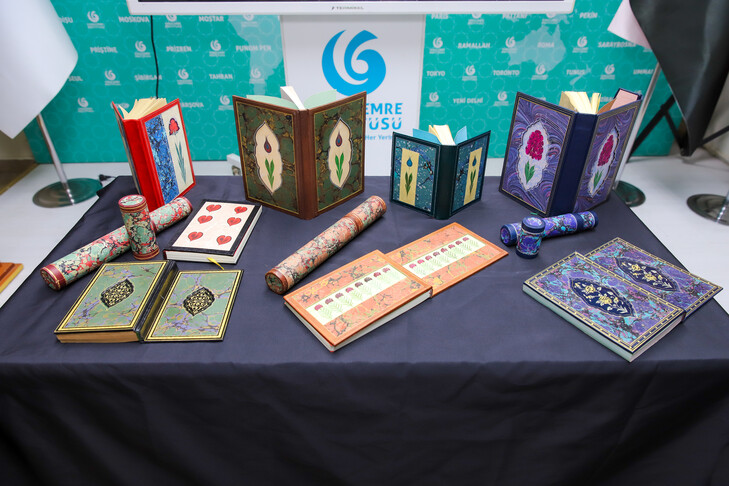
The Turkish Embassy in Cairo hosted the first day's events, where Ambassador Salih Mutlu Şen opened the program and two art exhibitions. The first, titled "Bahçe" (The Garden), features paper cutting art, while the second, titled "Colors of Knowledge," features ebru (marbling on water) decorative bookbinding.
The two exhibitions included 32 artworks by Selda Kavaş Avcı, faculty member in the Department of Traditional Turkish-Islamic Arts at Aydın Adnan Menderes University, and Songül Argun, lecturer at the Faculty of Arts, Design and Architecture at Sakarya University.
The displayed works reflected the richness of the Turkish-Islamic artistic heritage and gave visitors the opportunity to closely learn about its techniques and aesthetic characteristics.
Ambassador's Remarks and Shared Heritage
In a speech at the opening, Ambassador Şen stressed the importance of preserving, revitalizing and passing on traditional arts to future generations.
He noted that the displayed works not only reflect the aesthetics of classical Islamic arts, but also highlight the common ground between Turkish and Egyptian traditional arts.
He pointed out that Egypt hosts, at the Egyptian National Library (Dar al-Kutub), one of the richest collections of manuscripts after Turkey, stressing that it forms part of the shared cultural heritage of the two countries.
Statements from Participants
For her part, the coordinator of the Yunus Emre Institute in Cairo, Melihe Övsal, said the institute has contributed since 2010 to strengthening rapprochement between the Turkish and Egyptian peoples through its activities in Turkish language teaching, culture and the arts.
Övsal expressed her delight at the large turnout of Egyptians at the institute's events, stressing the importance of cultural and artistic activities in consolidating ties between the two countries.
Argun expressed her happiness at presenting her works, which combine ebru and bookbinding, before art lovers in Cairo.
She said: "Ebru is a dance of colors on the surface of water, an art that embodies patience, effort and refinement, while bookbinding brings this beauty to books to carry it into the future."
She added: "Both arts embody the values of patience, effort and aesthetic sensitivity, and every artwork carries the story of a color dropped onto the water and a touch that comes from the heart."
She also noted that presenting her artistic experience before the Cairo audience, with the city's ancient cultural and artistic heritage, is a source of pride and joy for her.
For her part, Avcı explained that paper cutting art involves hollowing out and decorating paper and leather with precision and skill. She noted that it developed in the Islamic world from the 15th century and held a prominent place among traditional Turkish book arts, particularly in the Ottoman era.
She stressed the importance of preserving this ancient art, passing it on to future generations and presenting it again with a contemporary artistic vision.
She said: "Through the Garden exhibition, which revolves around the concepts of blessing, continuity, renewal and the cycle of life, I sought to re-present the aesthetic and symbolic qualities of nature, using the techniques and formal methods of traditional Turkish paper cutting art."
She continued: "Believing in art's ability to build bridges of communication between cultures, I feel a special joy in presenting my works before art lovers in Egypt, with which we share deep historical and cultural ties."
Workshops and Wide Attendance
On the second day of the program, the Yunus Emre Institute hosted hands-on workshops introducing the arts of paper cutting and ebru.
The workshops saw wide attendance, as more than 300 people applied to take part, while 80 people participated.
During the workshops, which ran throughout the day, participants learned the basic techniques of both arts, were given the opportunity to create artworks themselves, and took commemorative photos with them.
Source: Anadolu Agency
Comments (0)