

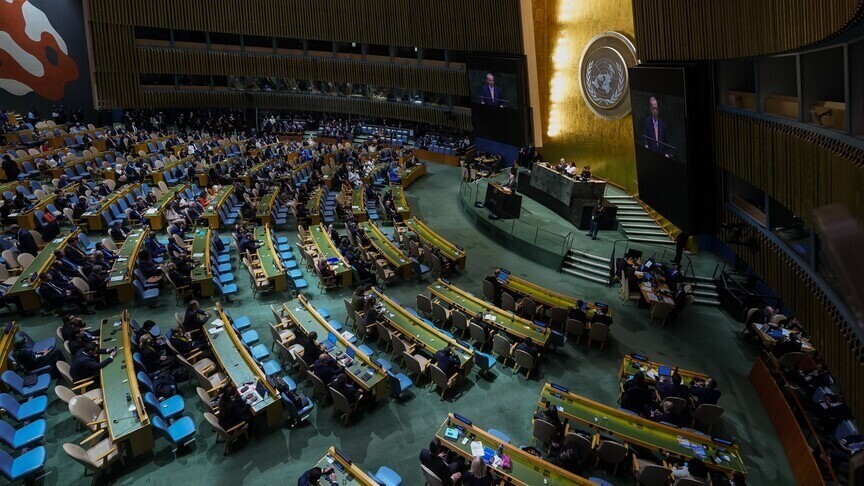
A committee of the United Nations General Assembly on Thursday adopted a draft resolution affirming the Palestinian people's right to self-determination and independence, with 162 countries in favor, 8 against and 8 others abstaining.
The vote took place in the Third Committee, which is responsible for human rights and humanitarian affairs, on the annual draft resolution on the right of the Palestinian people to self-determination.
Details of the Resolution and the Vote
The resolution affirmed the Palestinian people's right to independence and to live in their homeland free from Israeli occupation, describing it as an inalienable right that is not subject to any conditions or reservations and cannot be bargained over or negotiated.
The resolution drew on the advisory opinion of the International Court of Justice on the illegality of Israel's continued occupation of the Palestinian territories and the need to end it without delay, as it is an obstacle to Palestinians exercising their right to self-determination.
A total of 162 countries voted in favor of the draft resolution, including Canada, Australia, all European Union member states, and the majority of South American, Asian and African countries, according to the Palestinian news agency WAFA.
By contrast, 8 countries voted against it: the United States, Israel, Argentina, Paraguay, as well as Micronesia, Nauru, Papua New Guinea and Palau, while 8 other countries abstained.
Palestine's Position
For his part, the Permanent Observer of the State of Palestine to the United Nations, Riyad Mansour, said that "the State of Palestine is determined to move forward in strengthening international support for the rights of the Palestinian people, especially in light of the injustice and oppression they suffer at the hands of the Israeli occupation."
He added that this aims to "repel all Israeli attempts to strip away this international legal support in international forums, until the occupation is ended, justice is achieved, and the Palestinian people and their land are protected from the crimes of the occupation."
He also reiterated that every possible effort is being made to ensure the ceasefire in the war of genocide in the Gaza Strip is consolidated, aid continues to enter and is distributed adequately and effectively to save the lives of Palestinian civilians, and to move toward reconstruction and the restoration of life in the Gaza Strip.
He renewed his thanks to the countries that voted in favor of the resolution and called on them to work seriously to enable the Palestinian people to exercise their right to self-determination and to be freed from the Israeli occupation.
The Palestinian Foreign Ministry, in a statement, welcomed the adoption of the draft resolution, considering that the current challenge is no longer limited to reaffirming the right to self-determination, but lies in its actual implementation and protection.
It called on the international community to translate this political consensus into practical steps that end the Israeli occupation as soon as possible.
The Palestinian Foreign Ministry urged states to align their positions with international law by not recognizing the illegal situation resulting from the occupation or providing any assistance in sustaining it. It also called for protecting Palestinian land and institutions from settlement, annexation, forced displacement and settler terrorism.
The ministry stressed that the right to self-determination is inalienable and cannot be postponed, and is not subject to the will of the occupying power, emphasizing its link to the establishment of an independent Palestinian state with East Jerusalem as its capital.
Context of the Vote
The vote comes amid the continuing humanitarian repercussions of Israel's war of genocide on the Gaza Strip, which has left more than 74,000 Palestinians dead and over 175,000 injured since October 2023, most of them children and women, in addition to destruction affecting 90 percent of the infrastructure.
Alongside the war, the Israeli army and settlers have escalated their attacks on Palestinians and their property in the West Bank, including occupied East Jerusalem. The attacks include raids, arrests, home demolitions and the displacement of Palestinian communities, along with the expansion of settlement outposts, amid Palestinian warnings of an accelerating pace of settlement.
For decades, Israel has occupied land in Palestine, Syria and Lebanon, and it refuses to withdraw from it or to accept an independent Palestinian state with East Jerusalem as its capital, on the pre-1967 war borders.
Source: Anadolu Agency
Comments (0)