

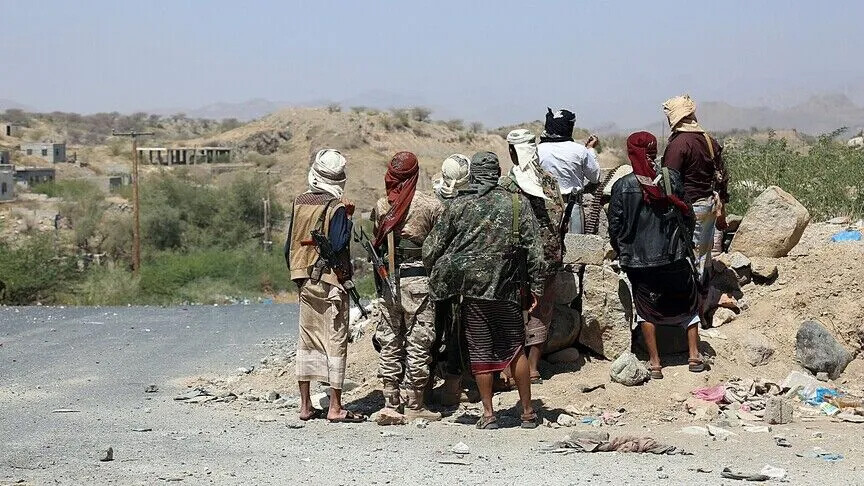
The Yemeni Army announced on Thursday that its forces repelled a Houthi group attack on the strategic Han Mountain west of Taiz city in the southwest of the country. This came in a statement published by Colonel Abdul Basit Al-Bahr, deputy head of the Moral Guidance Department in the Taiz Military Axis, on the Facebook platform.
For his part, Al-Bahr confirmed that the forces thwarted the attack after hours of the fiercest confrontations and most intense combat battles. He added that the enemy burned Han Mountain and all of the western front and residential neighborhoods with shells and heavy artillery, without mentioning human or material losses.
Strategic Importance of Han Mountain
Han Mountain is considered one of the most important strategic sites, as it overlooks the Fog Road, which is the only vital passage linking Taiz and Lahj Governorate, and from there to the temporary capital Aden to the south. The mountain also overlooks several neighborhoods west of Taiz city, giving it great importance in securing large areas.
Siege and Human Complications
The Houthi group closes most roads leading to areas under government control in Taiz Governorate, according to Yemeni human rights and humanitarian organizations. These organizations accuse the group of imposing a siege on the city since 2015 and preventing aid convoys, while the group denies these accusations.
Comprehensive Military Escalation
The Houthi group closes most roads leading to areas under government control in Taiz Governorate, according to Yemeni human rights and humanitarian organizations. These organizations accuse the group of imposing a siege on Taiz city since 2015 and preventing aid convoys from reaching the population and victims of the war, while the group denies these accusations.
Since October 5, the "Yemen Dawn" military operation has been ongoing, which President of the Presidential Leadership Council Rashad Al-Alimi said aims to restore state institutions from the Houthis and control the capital Sanaa. These developments fall within a military escalation that began last July, the widest since the relative calm Yemen witnessed thanks to a truce that began in April 2022.
Yemen has been witnessing a war since the Houthis seized control of Sanaa and several governorates in September 2014, before the intervention of an Arab coalition led by Saudi Arabia in March 2015 in support of the Yemeni government. Overall, the Houthis control most of the northern and western governorates, including Sanaa, Saada, Amran, and Dhamar to the north, Hodeidah to the west, Ibb to the southwest, and Al-Mahwit and Raymah to the northwest, and exert partial control in Hajjah, Al-Bayda, Marib, Al-Jawf, Ad-Dhale, and Taiz.
In contrast, government forces and their allies control the temporary capital Aden, and the governorates of Al-Mahra, Hadhramaut, Shabwa, and Abyan, most of Lahj and Ad-Dhale, and parts of Taiz, Marib, Al-Jawf, Hajjah, and Saada.
Source: Anadolu Agency
Comments (0)